Trump Administration Shut Down USAID and Cut U.S. Foreign Aid, Withholding Billions Congress Had Appropriated
The Trump administration shut down the U.S. Agency for International Development (USAID), canceling most of its programs and folding its remaining functions into the State Department, and cut U.S. foreign aid. This represents a major and durable shift in U.S. foreign policy. The broader aid literature is contested—critics like economist William Easterly argue aid fosters dependency, while defenders cite evidence it boosts growth. But economists generally agree health aid (vaccines, HIV treatment) works better than general development aid.
Mortality projections face methodological critiques but converge directionally: studies in The Lancet and other publications put the impact of the cuts in the range of roughly 7 million to 22 million additional deaths by 2030, with more conservative bottom-up estimates from the Center for Global Development (CGD) implying 500,000–1.6 million deaths per year. By mid-2026, running estimates of deaths already realized had converged around 700,000–750,000—Atul Gawande, USAID's former global health chief, put the figure at roughly 700,000 in a July 2026 New Yorker interview, citing Boston University tracking work, up from ~300,000–400,000 estimates in late 2025. Gawande frames the toll as "public man-made death"—a concept drawn from historian Richard Rhodes—and says a team of reporters he assembled has documented twelve hundred individually identified people who died directly from the aid shutdown. CGD charts showing cholera deaths rising as funding fell in 5 of 8 African countries provide further directional support.
DOGE itself was formally terminated on July 4, 2026, per the sunset date in Trump's original executive order, but the accountability fight over its USAID legacy intensified: after Rep. Ro Khanna (D-Calif.) said Elon Musk—now the world's first trillionaire—had "possibly sentenced to death" 4.5 million children, Musk called him a liar, threatened to sue, and claimed "not even a single dead child." This prompted NYT columnist Nicholas Kristof and others to name specific children (in Uganda, Liberia, South Sudan, Kenya, Nigeria, Afghanistan, Myanmar, and Sudan) who died after aid was withdrawn.
Musk has also downplayed his own role, framing DOGE's actions as mere fraud verification, though contemporaneous evidence (his "wood chipper" boast, Rubio's thanks to DOGE, and internal USAID memos) contradicts that.
No one is filling the gap: China focuses on infrastructure not health aid, Europe is also cutting development and humanitarian aid, African countries are increasing domestic spending but from a very low base ($40/person vs $4,000 in rich countries), and private philanthropy has mobilized only ~$125M to backfill the cuts—nowhere near the $60B+ annual shortfall. Separately, the administration has withheld $600 million in congressionally appropriated funding for Gavi, the global vaccine alliance, over vaccine-safety objections raised by HHS Secretary Robert F. Kennedy Jr.; the funds expire in September 2026, and the hold has drawn bipartisan objection.
Details
On January 20, 2025, President Donald Trump signed Executive Order 14169 "Reevaluating and Realigning United States Foreign Aid," suspending most U.S. foreign aid programs pending a 90-day review. This initiated the systematic dismantling of the U.S. Agency for International Development (USAID), the largest humanitarian donor in the world. By July 2025, USAID was effectively shut down, with over 5,000 programs terminated and fewer than 1,000 remaining.
Timeline of Events
January 20, 2025: Trump signs executive order freezing all foreign aid except emergency food assistance and military aid.
January 24, 2025: Stop-work orders issued to aid programs worldwide, including PEPFAR (President's Emergency Plan for AIDS Relief).
February 2, 2025: Musk calls USAID a "criminal organization," adding "Time for it to die." The next day he posts that he "spent the weekend feeding USAID into the wood chipper."
February 2025: Political appointees Peter Marocco and Jeremy Lewin (a 28-year-old with no government or aid experience) oversee rapid program terminations. According to ProPublica, appointees told staff the strategy was "shock and awe."
March 3, 2025: Nicholas Enrich, USAID's acting assistant administrator for global health, is placed on administrative leave after authoring internal memos projecting hundreds of thousands of preventable deaths from the cuts.
March 10, 2025: Secretary of State Marco Rubio announces review completion. 83% of USAID contracts canceled.
July 2025: USAID operations formally shuttered; remaining programs transferred to State Department.
August 2025: Congress passes Rescissions Act of 2025, cutting approximately $9 billion in foreign aid funding.
June–July 2026: The fight over the death toll erupts into public view after Rep. Ro Khanna says Musk "possibly sentenced to death" 4.5 million children. Musk threatens to sue Khanna, says he should be in prison, and insists "there is not even a single dead child." Kristof responds by naming children who died after the cuts.
July 4, 2026: DOGE is formally terminated—a sunset date written into Trump's original executive order creating it. Days later, in a New Yorker Radio Hour interview, Atul Gawande, USAID's former assistant administrator for global health, estimates that roughly 700,000 people have already died as a result of the cuts.
The Aid Effectiveness Debate
The academic literature on foreign aid effectiveness is genuinely contested. The World Economic Forum summarizes that "hundreds of academic studies... have resulted in fragile and inconclusive evidence" with three distinct camps: critics like economists William Easterly and Dambisa Moyo who argue aid fosters dependency and corruption; defenders like Jeffrey Sachs who cite evidence that sustained aid increases growth by roughly one percentage point per capita; and those who argue aid works only under certain institutional conditions. A State Department literature review (December 2024) found that of 30 studies analyzed, results were mixed due to methodological challenges including reverse causality (aid often targets countries with poor growth records).
However, most economists distinguish between development aid (general budget support, economic growth programs) and health aid (vaccines, HIV treatment, disease prevention). The evidence for health aid is considerably stronger: a 2020 meta-analysis found foreign aid has positive impacts on poverty "irrespective of the type of poverty measures used," particularly when targeted at health and agriculture.
PEPFAR: The Strongest Evidence Case
PEPFAR, established in 2003 under President George W. Bush, is widely regarded as one of the most successful global health programs in history—and the clearest example of aid that works. According to federal data, the program:
- Invested over $100 billion since inception
- Provided antiretroviral therapy to 20.6 million people annually, including 550,000 children
- Prevented an estimated 26 million AIDS-related deaths
- Reduced HIV/AIDS mortality from 2.2 million deaths (2003) to 390,000 (2023)
- Cut new infections from 3.2 million (2003) to 640,000 (2023)
PEPFAR's success is not seriously disputed even by aid skeptics because the causal chain is direct: provide HIV treatment, people don't die of AIDS. Kristof has pointedly noted the program's origins in making this case to conservatives: it was evangelicals and Republicans who launched PEPFAR in 2003, and he calls it "the single best aid program ever." A mathematical modeling study published in eClinicalMedicine estimated that the PEPFAR funding freeze would result in 60,000-74,000 excess HIV deaths and 35,000-103,000 new infections across seven sub-Saharan African countries by 2030. The World Health Organization warned that prolonged funding gaps could return global HIV mortality to 1980s levels of 630,000 deaths annually.
Projected Mortality Impact: The Lancet Study and Its Critics
A study published in The Lancet (Cavalcanti et al., July 2025) projected that USAID cuts could result in more than 14 million additional deaths by 2030, including 4.5 million children under five. The study analyzed data from 133 countries and estimated that USAID-supported programs were associated with a 15% reduction in all-cause mortality and had prevented 91 million deaths between 2001 and 2021.
Methodological Criticism (LessWrong)
The study faced detailed criticism from an independent researcher who attempted partial replication:
- The study controlled for 14 different factors (GDP, conflict, etc.) but didn't explain why these were the right ones to include—a choice that can dramatically affect results
- When the critic used a slightly different statistical method, the main result disappeared
- The way the study grouped countries into spending categories may have artificially inflated the findings
- Mortality data from poor countries is notoriously unreliable, as the WHO itself acknowledges
- The authors didn't publish their code or data, making full replication impossible
Lancet Correspondence (Different Criticism)
The authors' published reply to critics addressed different concerns raised by Alagar and Lobkowicz in The Lancet—who actually argued the 14 million figure underestimates deaths because it ignores the chaos of abrupt withdrawal, concurrent cuts by other donors (Germany, UK, France), and polio programs. The authors did not address the statistical methodology concerns raised in the LessWrong analysis.
The "Lives Saved" Critique and Rebuttal
The study's claim that USAID-linked programs saved roughly 91.8 million lives (including 30.4 million children under five) over two decades drew a separate line of attack. A Reason critique argued that only about 79 million lives were saved on net worldwide since 2001, so crediting USAID with 92 million would require attributing every saved life to U.S. aid plus tens of millions of "phantom" lives—implying the model overshoots the past and, by extension, the future. Writing in The Argument, Kobe Yank-Jacobs countered that this reasoning holds the 2001 death rate constant while the global population both grew and aged; simply keeping mortality at the 2001 rate would itself have been a large intervention, so exceeding 79 million saved lives is arithmetically possible and not "logically invalid." He nonetheless agreed the Lancet figure is a "high-end estimate," noting that more conservative CGD estimates and Brooke Nichols's tracker (roughly 260,000 adult and over 500,000 child deaths at the one-year mark) imply a lower—but still multi-million—death toll by 2030; on his accounting, even conservative projections reach at least 2.5 million deaths by 2030.
Other Modeling Approaches
A separate Lancet Global Health study (Stover et al., October 2025) projected 4.1 million additional AIDS deaths, 607,000 TB deaths, and 2.5 million child deaths by 2030. Unlike the Cavalcanti study, which used statistical regression to estimate how much past aid spending correlated with mortality reductions, this study used disease-specific epidemiological models—the same tools public health agencies use to predict how HIV and TB spread. The logic is more direct: we know how many people are on HIV treatment, we know what happens when treatment stops, and we can project deaths from there. This sidesteps the "did aid actually cause these improvements?" question, but it relies on a key assumption: that funding cuts translate proportionally into coverage drops. In reality, countries may reallocate resources to protect critical services. The authors acknowledge "considerable uncertainty" on this point.
A third major study, published in The Lancet Global Health in February 2026 (Rasella et al., Barcelona Institute for Global Health, supported by the Rockefeller Foundation), analyzed 93 low- and middle-income countries and modeled two scenarios. Under a "moderate" scenario reflecting the roughly 10.6% average aid reduction of the prior two years, it projected at least 9.4 million additional deaths by 2030, including 2.5 million children under five; under a "severe" scenario in which cuts deepen through the decade, it projected up to 22.6 million additional deaths, including 5.4 million young children. Looking backward, the study estimated that development assistance between 2002 and 2021 cut child mortality by 39%, HIV/AIDS deaths by 70%, and malaria and nutrition-related deaths by 56%. It was this study's 9.4 million figure—the lower, "current rates" scenario—that Kristof cited in his June–July 2026 columns.
On-the-Ground Impacts
The lethality of the cuts reflects how dependent many countries were on U.S. support. In the years before the second Trump administration, U.S. aid typically accounted for over a quarter of all development assistance given by every country combined, and in roughly twenty developing countries it exceeded 10 percent of domestic health expenditure—in Afghanistan, American aid equaled three times the country's own health spending. In 2024, the United States funded 50 to 60 percent of Côte d'Ivoire's AIDS response and 89 percent of the Democratic Republic of Congo's. By Gawande's account, DOGE's cancellation of more than 80 percent of USAID's programs cut basic health-care access for some 95 million people.
The result is that long-improving indicators have begun reversing for the first time in three decades. After the world halved under-five child deaths since 1990 (from 13 million a year to 4.9 million) and cut maternal deaths 40 percent between 2000 and 2023, an estimated 200,000 more children are believed to have died in 2025 than in 2024. More than 1,300 health and family-planning clinics have closed globally, and researchers have documented rising child marriage, violence against women and girls, and civil disorder in affected regions.
Much of what USAID funded was humanitarian response for people fleeing war, conflict, or disaster. By Gawande's account, where emergency-health services reached roughly 80 million people in 2024, the number reached in 2025 fell by more than 50 million—including some 14 million people suffering severe acute malnutrition, 2.5 million of them children, for whom U.S.-manufactured ready-to-use therapeutic food (the "peanut bar" distributed by community health workers) had cut the death rate to under one percent before the supply was severed. Ukraine, the single largest recipient of U.S. aid, lost energy infrastructure that kept heat running and services for some 3.5 million displaced children and pregnant women.
South Sudan Cholera Epidemic
ProPublica's investigation documented how funding cuts exacerbated a cholera outbreak in South Sudan. The epidemic infected over 100,000 people and killed at least 1,600—the worst in the country's history. Key findings:
- U.S. officials were repeatedly warned that cuts would worsen the outbreak but proceeded anyway
- Clinics funded by World Relief and other organizations were forced to close mid-outbreak
- IV bags that cost 62 cents each became unavailable, leading to preventable deaths
- Sanitation services in the Bentiu refugee camp (110,000 people) collapsed when funding stopped
- Secretary of State Rubio claimed no one died from aid cuts, which ProPublica found to be false
ProPublica documented specific individuals—including a woman who died 50 feet from a padlocked clinic and a baby who died on the day a mobile health team's visit was canceled—whose deaths appeared directly linked to service withdrawal. However, the causal picture is complicated: roughly 600 people died in the first three months of the outbreak while funding was still present (~200 deaths/month), compared to ~1,000 additional deaths over the following ten months after cuts (~100 deaths/month). This crude extrapolation does not show the spike one would expect if cuts directly worsened mortality. The article argues this apparent plateau reflects severe undercounting—clinics that track deaths were themselves closed, the WHO lost funding, and reporters found unmarked graves not in official tallies. A 2022 outbreak in the same region resulted in only one death with full U.S.-funded sanitation response.
A more rigorous Center for Global Development (CGD) analysis examined cholera mortality (orange line) against U.S. WASH/cholera funding outlays (green bars) and cancelled obligations (beige bars) across eight African countries from 2023-2025.
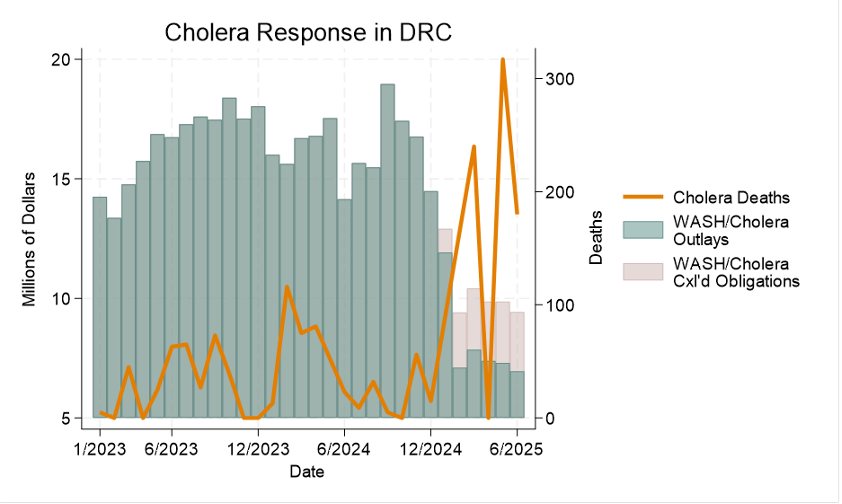
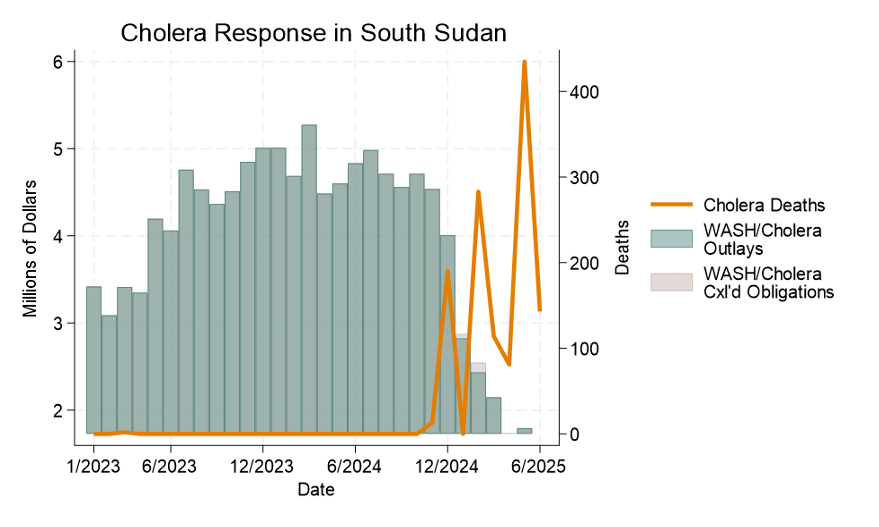
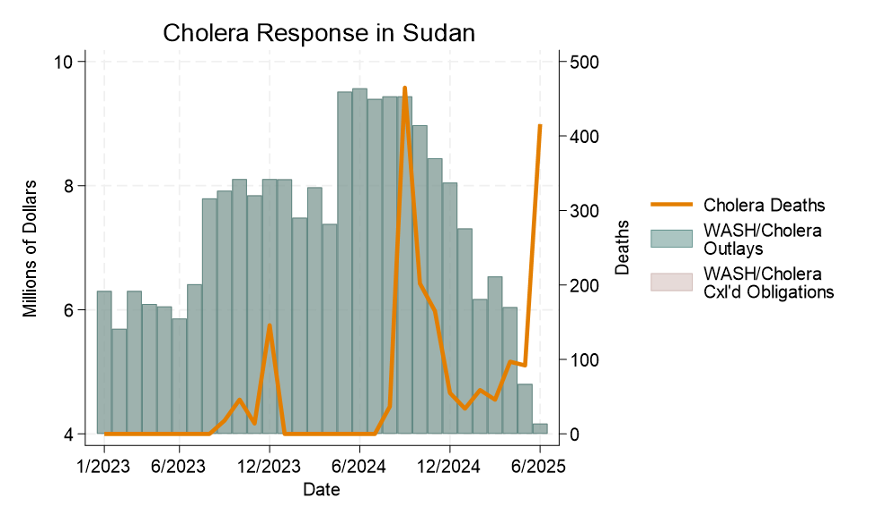
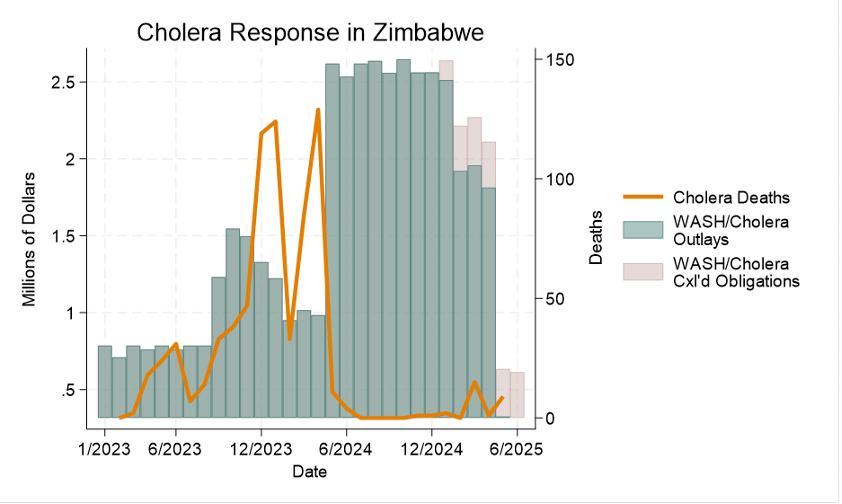
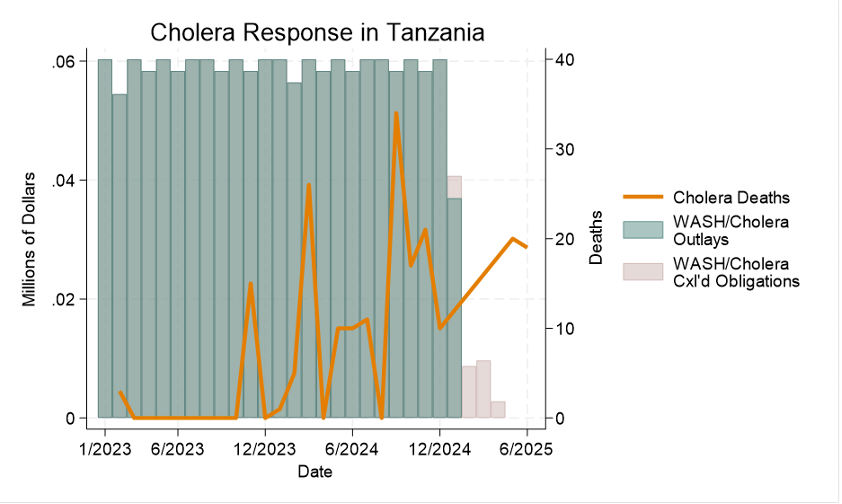
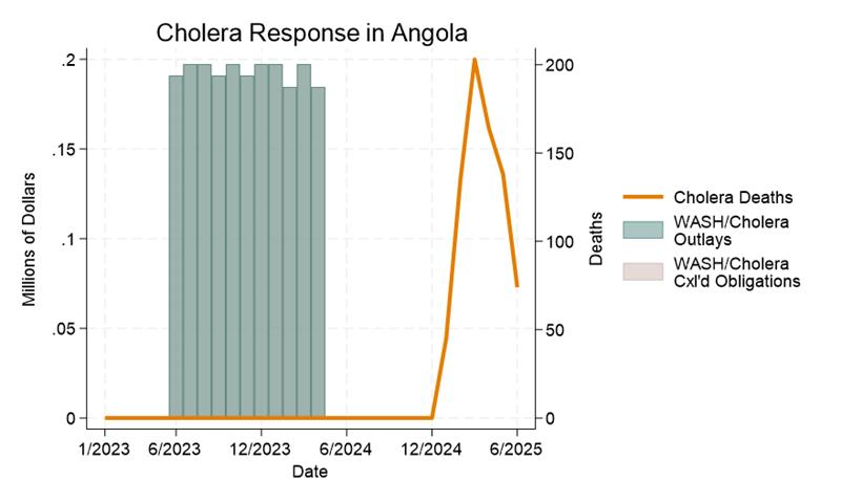
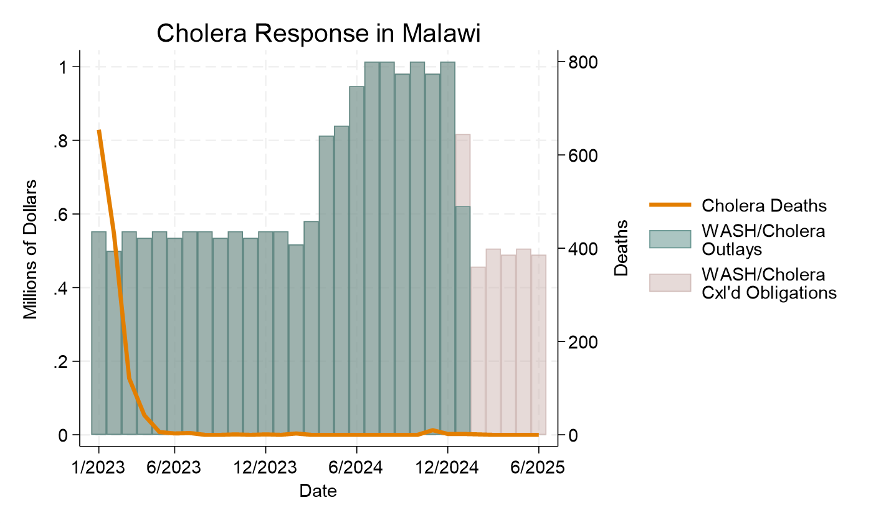
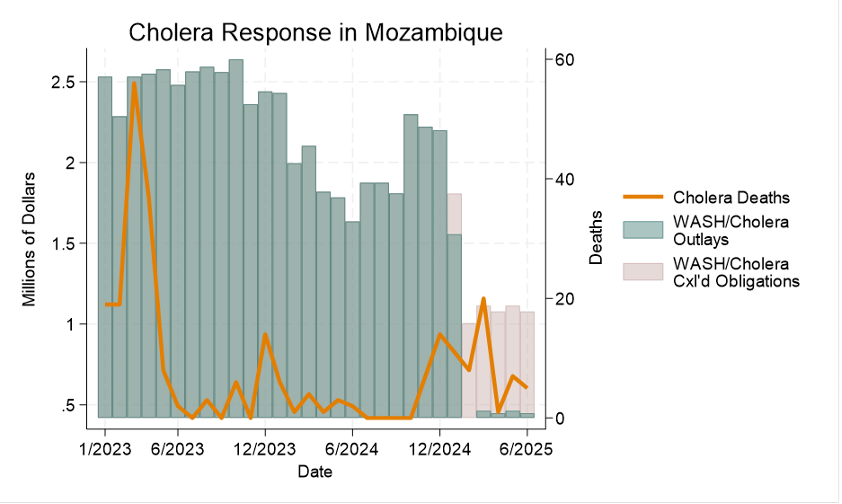
The pattern is mixed but suggestive. In several countries—DRC, South Sudan, Sudan, Zimbabwe, and Tanzania—cholera deaths spike sharply in early 2025 precisely when cancelled obligations appear and outlays drop. South Sudan shows deaths rising to ~400/month and Sudan to ~500/month coinciding with the funding cuts. However, Angola and Malawi experienced their major outbreaks earlier (mid-2024 and late 2023 respectively), with deaths already declining before the 2025 cuts took effect. CGD notes that "the long-term picture is sometimes more complicated" and "US programs often pursued broader objectives beyond immediate outbreak response," but concludes that "US assistance has contracted at precisely the moment when rising cholera cases require immediate medical response." The true causal impact remains difficult to establish definitively, but the correlation across multiple countries is notable.
South Sudan: Gawande's Field Findings
Gawande traveled to South Sudan—the world's youngest country, whose establishment the United States helped support and where the subcounties he visited had little functioning government service apart from U.S.-backed primary-health-care centers. He met Angelina David, the clinical manager for International Rescue Committee clinics in Panyijiar, who described a complete and abrupt shutdown: staff scrambling to move medicines off shelves before they could be looted, traveling seven or eight hours to reach the most remote facilities. Working with the local subcounty administrators (the "payam administrators"), who keep their own death records, Gawande found that their tallies showed an overall tenfold increase in child and adult deaths—child deaths across seven subcounties rising from 42 recorded over 2023–2024 to 214.
He also collected individual cases. In a community called Machar, a woman named Nyajiek Gai Guol was caring for a two-year-old niece who developed pneumonia; the clinic that would have treated the girl had closed, and reaching care meant a three-hour journey on foot and by canoe. The child arrived alive but had already gone into organ failure and died—a death Gawande described as completely avoidable. As he left the country, he encountered an official from China Aid arriving to offer assistance, an early sign of the soft-power vacuum the cuts have opened.
Kenya Refugee Camps
In Kakuma refugee camp (308,000+ people), food rations were slashed after World Food Programme funding was withheld. Medical workers reported starving women giving birth to premature babies, and UNICEF projected over one million children and pregnant women would be denied treatment for acute malnutrition.
African Health Systems
NPR reported that organizations in Zambia, Tanzania, and Ethiopia received termination letters forcing immediate shutdown of HIV/TB programs. A Zambian health official warned of potential "superbugs" emerging as patients can no longer adhere to medication regimens.
Estimated Death Toll
Multiple studies have attempted to quantify the humanitarian impact. Two kinds of numbers circulate and are often conflated: projections of deaths by 2030 if the cuts persist (the Lancet-family studies discussed above, ranging from roughly 2.5 million on conservative assumptions to 22.6 million in the most severe scenario), and running estimates of deaths that have already occurred:
- Boston University epidemiologist Brooke Nichols created a real-time impact tracker estimating deaths from halted HIV/AIDS, tuberculosis, malaria, malnutrition, and maternal-child health programs; her model initially projected roughly 367,000 deaths per year of stoppage, and by the one-year mark implied roughly 260,000 adult and over 500,000 child deaths
- The Center for Global Development (Charles Kenny and Justin Sandefur, updated December 2025) estimated 500,000 to 1 million lives lost per year based on actual outlay declines—670,000 to 1.6 million based on cancelled obligations—using cost-effectiveness benchmarks of $3,457 per life saved for global health spending and $17,837 for humanitarian and food aid. Documented disruptions underlying the estimate include 2.3 million people losing antiretroviral (HIV) treatment support and 2.4 million people in Yemen losing food assistance
- By mid-2026 the running estimates had converged around 700,000–750,000 realized deaths, up from ~300,000–400,000 in late 2025. Kristof cited the Boston University figure of more than 750,000 lives lost worldwide; Atul Gawande, in a July 2026 New Yorker interview with David Remnick, put the estimate at roughly 700,000, and Harvard's School of Public Health has said the shutdown "has led to hundreds of thousands of deaths"
- Alongside the model-based estimates, Gawande has described assembling a team of reporters and journalists to compile a tracker of individually verified deaths, which he says has documented not only the systems that collapsed but "twelve hundred different individually identified people who have directly died from the shutdown of foreign aid"—a bottom-up counterpart to the statistical projections
- NPR documented individual deaths, including a 7-year-old Nigerian boy who died when a USAID-funded clinic closed
Gawande frames the aggregate toll using a concept the historian Richard Rhodes introduced in a 1988 Journal of the American Medical Association essay, "Man-made Death: A Neglected Mortality": deaths caused not by disease or accident but by deliberate policy—artificially induced famine, the willful dismantling of public-health infrastructure. Gawande calls the USAID shutdown an instance of "public man-made death," and much of the July 2026 New Yorker interview turns on the argument that these deaths, though diffuse and statistically buried in a survival rate that ticks from 97 percent to 96 percent, are as real and as attributable as deaths in war.
These running estimates are model-based, not body counts—Kristof himself cautions that the figures "may not be accurate" because mortality data is weak and the cuts also gutted data collection—but they rest on well-established relationships between treatment interruption and death for diseases like HIV, TB, and malaria.
Secretary of State Rubio testified before Congress that "no one has died because of USAID" cuts. NPR investigated and documented specific deaths, including children denied care at shuttered clinics. When Musk departed government in May, he claimed on X that "zero people have died" from USAID cuts.
In a May 9, 2026 opinion column, Times columnist Nicholas Kristof—who had reported firsthand from several African countries on children dying after the cuts—reiterated that a Boston University researcher estimated the reductions had cost more than 750,000 lives in their first year and cited a Lancet projection of millions more deaths by 2030. Kristof characterized the administration's action as a 71% cut in humanitarian aid from 2024 to 2025. Kristof wrote that the administration spent an estimated $6.4 billion closing down USAID—a sum that "could have saved more than one million children's lives"—and pointed to a new book, Into the Wood Chipper, by former USAID health official Nicholas Enrich, chronicling the agency's dismantling. Musk, responding to Kristof's reporting on X, wrote that "Kristof is lying through his teeth." That exchange escalated over the following two months into the public dispute detailed below (see "The 2026 Musk–Khanna Dispute and the Accountability Question").
Specific Organizational Impacts
The New York Times documented the human cost of specific program cuts:
- Plan International USA: Lost 13 grants, including food aid in Ethiopia and an education program in Nepal to keep girls in middle school to avoid early, forced marriages. CEO Shanna Marzilli said: "When we left, a lot of parents could no longer afford to send their children to school."
- Alight: Had to pause offering food and medicine for refugees in Sudan; stopped providing services entirely in South Sudan
- Center for Victims of Torture: Received stop-work orders on January 24; by the following Monday had to stop paying 75% of staff, forcing closure of centers serving thousands. Senior director Scott Roehm expressed particular concern about possible suicides among the torture victims they served
As the Times noted: "It's the small numbers that hurt people." 80% of DOGE's contract and grant cancellations claimed savings of $1 million or less—amounts that meant little to the federal budget but were devastating to recipients.
The 2026 Musk–Khanna Dispute and the Accountability Question
Through 2026 the argument over whether the cuts killed anyone escalated from a policy dispute into a personal and public confrontation involving Elon Musk, Rep. Ro Khanna, and Nicholas Kristof. It reached its peak just as DOGE itself was formally terminated on July 4, 2026—the sunset date in Trump's original executive order—and as Musk, newly become the world's first trillionaire, continued to deny any deaths. The exchange is worth separating into three distinct questions: whether Musk actually cut global health aid, how many people the cuts will kill, and whether Musk should face oversight for it.
"Not a Single Name": Musk's Denials and Kristof's Response
On June 22, 2026, Rep. Ro Khanna (D-Calif.) argued that Musk should be investigated for dismantling USAID, saying that while people celebrated the roughly 4,400 millionaires created by SpaceX's IPO, "they don't talk about the 4.5 million children around the world who he possibly sentenced to death by dismantling USAID." The 4.5 million figure comes directly from the Cavalcanti et al. Lancet study's estimate of children under five among the projected 14 million deaths by 2030.
Musk responded by calling Khanna a liar, threatening to sue him ("time to sue this liar"), and posting that "Liars and stock insider traders like Ro the Robber should be in prison." He then made a stronger empirical claim—"There is not even a single dead child!"—and challenged critics to "cite a single name of someone who died... Not a single name!"
Kristof, who had reported from several African countries on families whose children died after the cuts, answered the challenge directly in a July 1, 2026 column headlined "U.S.A.I.D. Cuts Killed People. That's the Truth.", naming three:
- Jibia, a 10-year-old girl who ranked third in her fourth-grade class in Rwamwanja, Uganda. After the local clinic ran out of $2 bed nets and anti-malaria medicine, she died of malaria in July 2025; Kristof reported that medical records confirmed the death and that health workers said a new bed net or drugs would likely have saved her.
- Yamah Freeman, a pregnant woman in Liberia who hemorrhaged. U.S.-provided ambulances at the local hospital had no fuel because of the aid cuts; villagers carried her toward town on their shoulders, but she bled to death along the way. Kristof visited her grave.
- Achol Deng, an 8-year-old in South Sudan infected with HIV at birth and kept alive by American-provided medicine costing about 12 cents a day. After USAID's dismantling she lost her caseworker and access to the drugs and died of an opportunistic infection.
Musk dismissed the reporting, writing that "Kristof is lying through his teeth." Kristof, for his part, acknowledged that the aggregate mortality figures "may not be accurate" given weak data, but maintained that the cuts are "unquestionably costing the lives of many children," and framed the underlying tradeoff in cost terms: U.S. aid had run to about 23 cents per $100 of gross national income and, by one CGD estimate, saved a life roughly once every 10 seconds. He also argued the cuts carried self-interested costs—suggesting the then-current Ebola outbreak in Africa may have escaped control precisely because U.S. aid to the region was cut—and closed with a challenge of his own: that Musk accompany him on a reporting trip to South Sudan, Somalia, or Mozambique to "meet starving children whose lives can be easily saved."
Kristof was not the only one to answer Musk's "single name" challenge. Journalists and researchers have documented a growing roster of named children who died after the cuts. Dr. Atul Gawande, who led USAID's global health work under President Biden and is now at Harvard's School of Public Health, documented the death of a girl named Jane Naboi, who starved in a Kenyan refugee camp after USAID-funded food rations were cut to 40 percent of daily caloric needs. The Associated Press reported on two-year-old Mohammed Hashim, who died of malnutrition in his father's arms in Myanmar after his rations stopped; the BBC told the story of Shahnaz, an Afghan woman who bled to death on a dirt road after her USAID-funded clinic closed, her newborn dying shortly after. Writing in The Bulwark on June 29, 2026, Lauren Dobson-Hughes compiled a longer list of roughly fifteen such children—each with a documented source—including one of Yagana Bulama's newborn twins in Nigeria (malnutrition), one-year-old Mohammad Omar in Afghanistan (malnutrition and meningitis), and siblings Nada and Omer, who starved in Sudan, alongside cases in Kenya, South Sudan, Myanmar, and Zambia: a direct rebuttal to Musk's insistence that there was "not even a single dead child." Dobson-Hughes emphasized that the cuts produced the first reversal in three decades of steadily falling child mortality. Forbes reported on July 1, 2026 that Musk continued to escalate his unproven denials even as studies linked the DOGE cuts to child deaths.
Did Musk Actually Cut the Aid?
A second thread of Musk's defense was to minimize his own role. On June 24, 2026 he contended that "All DOGE required was contact information of the recipients to confirm that funding was not fraudulent," implying DOGE ran a narrow fraud-verification layer rather than a mass shutdown. The contemporaneous record complicates that framing. On February 2, 2025, Musk called USAID a "criminal organization" and said "Time for it to die"; the next day he boasted of having "spent the weekend feeding USAID into the wood chipper." Rubio publicly thanked DOGE for the "historic reform" when he announced the cancellation of 83% of programs. And according to the Associated Press, when contract officers requested paperwork documenting the cancellations, a Musk associate replied only that the order came from "the most senior levels"—one attorney, Kenneth Bledsoe, described being effectively abandoned amid mobs and gunfire in the Democratic Republic of Congo as U.S.-funded operations collapsed.
Musk's fraud rationale rested largely on his repeated claim that only 10% of USAID payments reached their intended targets. As the Center for Global Development explains, that 10% figure is actually the share of funds channeled through local organizations; the rest flowed through international organizations that also deliver aid at scale, so the number describes which intermediaries handled the money, not whether it reached recipients. There is a legitimate, cross-partisan argument that more should flow through local groups—former Biden global-health official Atul Gawande has said he aimed to raise the local share from 10% to 30%—but that is a different question from whether aid was reaching people.
Even on Musk's own account, the "fraud verification" framing sits uneasily with the internal warnings the administration received. Nicholas Enrich, USAID's acting assistant administrator for global health, wrote a series of memos projecting the likely consequences of the shutdown—including as many as 166,000 additional malaria deaths and 18 million additional malaria cases per year, roughly 200,000 children paralyzed by polio annually, one million children going untreated for severe acute malnutrition each year, and a 30% rise in drug-resistant tuberculosis. Enrich blamed political leadership at USAID, the State Department, and DOGE for obstacles that "wholly prevented implementation" of lifesaving programs, and was placed on administrative leave.
Should Musk Answer for It?
The final strand of Khanna's argument is procedural: because Musk operated as a "special government employee" advising the president rather than an official confirmed by the Senate, he wielded enormous influence over the federal government while largely escaping congressional oversight. As Yank-Jacobs notes in The Argument—in a June 26, 2026 piece bluntly titled "Yes, Elon Musk is responsible for the deaths of millions"—Musk himself has argued that "the public's elected representatives... decide what happens, as opposed to a large, unelected bureaucracy"—a standard that arguably cuts against his own unelected, unconfirmed role. Khanna's position is that Musk "needs to answer for what he did with DOGE," and that a House investigation could follow if Democrats win the 2026 midterms. With DOGE's formal termination on July 4, 2026, no institutional locus of responsibility remains: the agency that executed the cancellations no longer exists, its chief left government in May 2025, and no official has been sanctioned in connection with the cuts. Notably, even some of Musk's defenders implicitly concede the cuts will cost lives: one widely shared rebuttal argued the Lancet projection describes a "fake world" because the cuts are unlikely to remain in place through 2030—an argument that, as critics pointed out, presumes the cuts would have to be reversed to avert the deaths.
Rubio's own role has drawn parallel scrutiny. In a July 8, 2026 Foreign Policy essay, Amanda Klasing of Amnesty International USA argued that the secretary of state—once known in the Senate as a human-rights advocate who declared "the United States must remain adamant in the defense of human rights"—should be seen as "the chief architect of the Trump administration's assault on the rules-based order," having led the dismantling of USAID as its acting administrator while adopting the slogan "We are not here to play social worker. We are here to win." (The essay is an advocacy piece, but the underlying record—Rubio's execution of the freeze, his announcement of the 83% cancellation, and his congressional testimony that no one died—is documented above.)
The Gavi Vaccine Funding Standoff
Separately from the USAID cuts, the administration has withheld $600 million that Congress appropriated for Gavi, the Vaccine Alliance—a public-private partnership co-founded by the U.S. in 2000 that, according to CIDRAP, has vaccinated more than 1.1 billion children across 78 low- and middle-income countries and provides vaccines for 20 diseases including measles, malaria, and polio. Congress appropriated $300 million each for fiscal years 2025 and 2026; the funds expire on September 30, 2026, if not released.
The hold has been driven by Health and Human Services Secretary Robert F. Kennedy Jr., a longtime vaccine skeptic, rather than by the State Department that historically manages the funding. HHS said it was withholding the money in part because Gavi declined to develop a plan to phase out vaccines containing thimerosal—a preservative Kennedy links to neurodevelopmental harm, a claim the scientific consensus rejects—and because Gavi had not provided a detailed accounting of how U.S. funds are used. In June 2025, Kennedy told Gavi leaders the U.S. would withhold support until the group had "re-earned the public trust." Gavi, which relies on the U.S. for roughly 15% of its budget, says its vaccines are safe and that the appropriated funds are due.
The withholding drew bipartisan objection. In May 2026, Senate appropriators—including Republicans Susan Collins, Mitch McConnell, and Lisa Murkowski alongside Democrats Patty Murray, Jeanne Shaheen, and Brian Schatz—wrote to Secretary Rubio urging the money's release. Rubio subsequently told the Senate Foreign Relations Committee that the State Department would "reengage" on Gavi and try to "drive this to an outcome," noting that President Trump had asked Kennedy to "play a leading role" given his vaccine-safety views. Columnist Nicholas Kristof, citing Gavi's own estimate, wrote that the collapse in vaccine funding could cost 600,000 lives by 2030.
Public Perception vs. Reality: The Budget Misconception
Americans dramatically overestimate how much the federal budget goes to foreign aid. When asked to estimate the percentage, most Americans guess figures that are 20-30 times higher than reality:
| What Americans Believe | The Actual Facts |
|---|---|
| Average estimate of foreign aid's share of budget: 26% (KFF) | Actual share of federal budget: ~1% (Pew Research) |
| Over half of Americans think it's at least 20% (U. of Maryland) | As share of national income, U.S. ranks near bottom of wealthy nations (Brookings) |
| When asked what it should be, Americans say 10% (U. of Maryland) | Actual cost per American: ~$64/year (17 cents/day) (UCLA) |
According to KFF polling, only 11% of Americans correctly identified that foreign aid accounts for about 1% or less of the federal budget. University of Maryland polling found that 89% of Americans—including 84% of Republicans—support spending at least 1% of the budget on foreign aid (the current level).
The Pew Research Center notes that while the U.S. spends more in absolute dollars on foreign aid than any other country, as a percentage of Gross National Income it ranks near the bottom among wealthy nations (below 0.2%, compared to the international benchmark of 0.7%). Brookings observes that five countries (Norway, Sweden, Luxembourg, Denmark, and the U.K.) exceed the 0.7% benchmark, while the U.S. ranks near the bottom.
Legal Challenges
The aid freeze faced multiple legal challenges:
-
February 7, 2025: U.S. District Judge Carl Nichols (a Trump appointee) temporarily blocked the administration from placing 2,200+ USAID employees on administrative leave, ruling unions had demonstrated "irreparable injury"
-
February 14, 2025: U.S. District Judge Amir Ali ordered the administration to temporarily restore funding, ruling the freeze likely violated federal law and the Constitution
-
February 26, 2025: The Supreme Court temporarily paused the lower court's order in a 5-4 decision, though Chief Justice Roberts and Justice Barrett joined the three liberal justices in a prior ruling directing the judge to clarify his order
-
March 18, 2025: U.S. District Judge Theodore Chuang ruled that Musk and DOGE "likely violated the Constitution" in multiple ways, including the Appointments Clause and separation of powers. The judge wrote: "There is no statute that authorizes the Executive Branch to shut down USAID" and that Musk "usurped the authority of the public's elected representatives in Congress"
-
September 26, 2025: The Supreme Court ruled 6-3 to allow the administration to withhold over $4 billion in congressionally appropriated foreign aid through a "pocket rescission." Justice Kagan dissented, writing that the ruling allows "the Executive to cease obligating $4 billion in funds that Congress appropriated for foreign aid, and that will now never reach its intended recipients"
Administration Response
A senior State Department official told ProPublica that drastic changes were necessary to reform a "calcified system" and maintained that nobody died as a result of funding cuts: "Who is responsible for the suffering of the people of South Sudan? The South Sudanese [government leaders] who take their oil revenues and buy private jets... Or the United States? Are we responsible for every poor person all around the world?"
In May 2026, Jeremy Lewin, the acting under secretary of state for foreign assistance, disputed reporting that the cuts had caused deaths, saying that "contrary to false media narratives, the data shows that President Trump's foreign assistance review maintained and improved frontline lifesaving programs, while reducing NGO bloat and costs." The administration has also pointed to steps it says preserved or expanded certain programs, including broader use of the long-acting HIV-prevention drug lenacapavir.
The administration announced a shift toward "trade over aid," prioritizing self-reliance agreements requiring recipient nations to share costs. The 2025 National Security Strategy formalized this shift, stating that U.S. policy in Africa has "for far too long" focused on "providing, and later on spreading, liberal ideology." The strategy calls for transitioning "from an aid-focused relationship with Africa to a trade- and investment-focused relationship," emphasizing energy and critical mineral development. Analyst Ken Opalo argues this creates genuine opportunities in LNG, nuclear energy, and critical minerals. However, Bright Simons of mPedigree cautions that the "critical minerals" narrative is overstated—Africa holds less than 2% of global rare-earth output, though it has significant deposits of iron, copper, manganese, and phosphate.
Strategic Implications: Who Will Fill the Gap?
The cuts have broader implications beyond immediate humanitarian impact. Development assistance for health globally is projected to drop from $80.3 billion in 2021 to under $40 billion in 2025.
Geopolitical Vacuum
NPR reported that China is moving to fill parts of the vacuum the U.S. leaves behind, particularly in Southeast Asia and Africa. The Council on Foreign Relations noted that "the suspension of health, education, and humanitarian programmes – key pillars of US soft power – may create vacuums that China can fill." The Global Taiwan Institute warned that dismantling USAID "hands China an opportunity to expand its global influence" and weakens Taiwan's fragile network of diplomatic allies.
But will China actually replace U.S. health aid? Analysts say no. Brookings notes that China's foreign aid from 2013-2018 totaled about $42 billion, compared to the U.S. spending $44-50 billion annually over the same period. More importantly, Chinese aid focuses on infrastructure, trade, and political influence—not vaccines, HIV drugs, or maternal health clinics. As Bright Simons of mPedigree told The Africa Report: "China does not buy vaccines, distribute HIV drugs or pay for gender mainstreaming in schools in Africa because those are not part of its strategy."
China has made some gestures: $4 million (with South Korea) to the Africa CDC, $500 million pledged to the WHO after U.S. withdrawal, and stepped in with identical programs when the U.S. defunded child literacy and landmine clearance in Cambodia. But CGD emphasizes these are "largely cosmetic"—in Cambodia and Africa CDC, China provided "a fraction of the resources that the US was providing." The soft power implications remain real: Semafor reports China is positioning itself as "a reliable partner in the face of uncertainty," and Council on Strategic Risks documents how China provided faster earthquake response in Myanmar after U.S. aid was limited. The tradeoff may be: fewer deaths prevented, but U.S. soft power eroded regardless.
Pandemic Preparedness
Disease surveillance systems built over decades were disrupted, potentially compromising early warning capabilities. The Council on Strategic Risks noted that the cuts threaten U.S. national security interests. By mid-2026 Kristof was arguing the risk had materialized, suggesting the Ebola outbreak then underway in Africa "may have gotten out of control precisely because we cut aid spending in the region."
Workforce and Institutional Destruction
According to the Real Instituto Elcano, approximately 3,000 State Department officers left the department in 2025, including 1,350 fired and 1,600 through voluntary retirement. Newsweek reported U.S. nonprofits cut staff by 50-60%, with some organizations like EnCompass losing over 400 jobs in less than a month.
As former development worker Christy Grimsley told Newsweek: "Taking something, dismantling something, is relatively cheap, but reestablishing it—finding that expertise, building those relationships, reestablishing the trust—will take years." The Lowy Institute concluded: "Gutting USAID has not just disrupted global aid; it has undermined a pillar of US foreign policy."
Europe
Rather than stepping up, European donors are also cutting. Development Today reports Germany announced €4.8 billion in cuts to development and humanitarian spending; France slashed €800 million from its 2024 foreign aid budget; the Netherlands is trimming aid under its new right-wing coalition. The EU itself cut its main development aid instrument by 7.48% for 2025-2027 and is considering a 35% reduction for 2028-2034. EU Commission President von der Leyen has stated the EU will not be "the lender of last resort." A European Parliament analysis concluded the $60 billion gap "neither Team Europe... nor other donors can fill."
African Countries
The cuts have accelerated calls for self-reliance that predate 2025. At the Accra Health Sovereignty Summit in August 2025, African heads of state called for "health without aid" and committed to mobilizing domestic resources. Nigeria's legislature approved an additional $200 million for health in its 2025 budget. Ghana's president directed the Finance Ministry to bridge the USAID gap. Both countries have introduced sugar-sweetened beverage taxes to expand health funding. Kenya is restructuring its health insurance system. An Afrobarometer survey found 65% of respondents across 34 African countries wanted their governments to finance development domestically rather than with external loans.
However, the scale of the challenge is daunting. Chatham House notes that sub-Saharan Africa spends just $40 per person annually on health, compared to $4,000 in high-income nations. Nigeria alone lost over $600 million in health funding—equivalent to one-fifth of its entire annual health budget. The institutional building blocks exist (Africa CDC, African Medicines Agency, growing regulatory capacity), but a 2024 analysis found African government health spending was "rising too slowly to offset these losses."
Private Philanthropy
Has mobilized but cannot approach the scale needed. GiveWell directed approximately $46 million to high-impact programs. The Project Resource Optimization initiative, led by former USAID staff, raised over $110 million for 80 programs. Total private response is estimated at roughly $125 million—against a $60+ billion gap. CGD concluded "private philanthropy simply can't fill the gap." Bill Gates personally warned the administration that the Gates Foundation cannot replace federal funding.
Private Sector
The hope that private investment could substitute for aid has not materialized. A BMJ Global Health analysis notes that "the hope to move 'from billions to trillions' for global development by mobilising private sector funds failed—particularly in global health." CGD notes there is a "lack of private-sector readiness to respond" and the private sector is "unlikely to fund politically sensitive health services for marginalized groups." Some innovative models exist—the Open Road Alliance provides bridge loans to NGOs facing funding crises—but these remain small-scale.
The Bottom Line
No combination of alternative funders can replace U.S. government aid in the near term. The most likely outcomes are: (1) services simply stop in many places, (2) China gains soft power without providing equivalent health aid, (3) some African countries accelerate self-reliance but with a painful transition period, and (4) the global health architecture is permanently restructured around lower funding levels. As IHME's Joseph Dieleman put it: "I don't expect a rebound by 2030 in any way. I think we're going to flatline at a new low."