Trump Creates Department of Government Efficiency Led by Elon Musk; Agency Disbanded After 10 Months, Charter Formally Expired July 4, 2026
DOGE failed to achieve its core mission of reducing federal spending—spending actually increased during its tenure—while causing massive disruption to federal agencies and humanitarian programs. Its charter formally expired ("self-deleted") on July 4, 2026, with a final savings claim of $215 billion against Musk's original $2 trillion promise; a New York Times analysis had found 28 of the top 40 savings claims inaccurate.
Roughly 300,000 federal workers lost their jobs, with The Atlantic documenting how top experts and skilled practitioners left disproportionately, severing the chain of institutional knowledge.
The dismantling of USAID had catastrophic humanitarian consequences: by mid-2026, former USAID global-health chief Atul Gawande and Boston University modelers estimated roughly 700,000–750,000 deaths already attributable to the cuts, a toll Musk flatly denies.
The initiative demonstrated that the promised "fraud and waste" did not exist at the scale claimed.
Details
Creation and Initial Promises
President Donald Trump established DOGE by executive order on January 20, 2025, his first day in office. The order reorganized the existing United States Digital Service—created under the Obama administration—into the U.S. DOGE Service, tasking it with "modernizing Federal technology and software to maximize governmental efficiency and productivity." The order contained a built-in termination clause: the charter would expire on July 4, 2026. Trump had said a smaller, more efficient government would be "the perfect gift" for America's semiquincentennial.
Trump first announced the initiative in November 2024, naming Elon Musk and Vivek Ramaswamy as co-leaders. Ramaswamy departed before Trump took office, leaving to run for governor of Ohio. Musk served as a "special government employee," a classification limiting him to 130 working days per year.
Musk's savings promises escalated and then collapsed:
- November 2024: Musk promised "at least" $2 trillion in annual savings
- Early 2025: Revised estimate down to $1 trillion
- April 2025: Further revised to $150 billion
- Final claim (2026): $215 billion, advertised as $1,335.40 per taxpayer—a figure independent analysts have long disputed
- Actual verified savings: Between $60-160 billion, with some analyses showing even less
According to analysis by Slow Boring, DOGE's actual savings fell hundreds of billions of dollars short of projections—"not because Musk and his team are stupid or lazy, but because the fraud genuinely does not exist."
The "Wall of Receipts": Errors and Exaggerations
A comprehensive New York Times analysis of DOGE's published "Wall of Receipts"—where the group tallied its claimed successes—found systematic errors and exaggerations:
Scale of Inaccuracy:
- Of the 40 largest savings claims, only 12 appeared accurate
- The 13 largest claims were all incorrect
- 28 of the top 40 claims were inaccurate
- The two largest false entries ($7.9 billion in claimed Defense Department "terminations") were bigger than 25,000 of DOGE's other claims combined
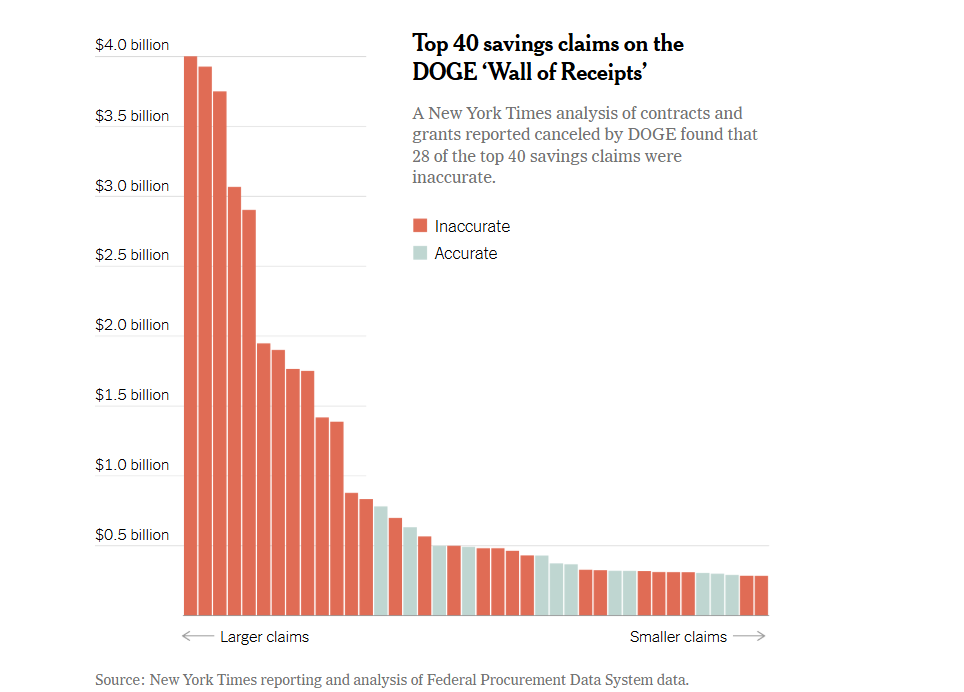
Source: New York Times reporting and analysis of Federal Procurement Data System data.
Types of Errors Identified:
The Times documented several categories of errors:
- Double-counting: DOGE claimed credit for canceling the same Department of Energy grant twice, adding $500 million in duplicate savings
- Timeline errors: One contract DOGE claimed credit for had been terminated by the Biden administration weeks before DOGE began. Three pandemic-era pharmacy contracts ($6 billion claimed) had simply expired on schedule
- Misclassifications: Seven programs DOGE claimed to have terminated were not dead, including four resurrected by court rulings
- Exaggerations: In 16 cases, DOGE greatly exaggerated cuts using an accounting trick
The "Ceiling Value" Accounting Trick:
DOGE's most common exaggeration involved lowering the "ceiling value" of contracts—the theoretical maximum the government could eventually pay—without changing actual spending.
Travis Sharp of the Center for Strategic and Budgetary Assessments told the Times: "Does lowering the maximum limit on your credit card save you any money? No, it does not."
Example: DOGE claimed $700 million in savings from a 10-year Pentagon IT contract with the firm CACI by lowering its ceiling from $5.7 billion to $5 billion. CACI's CEO John Mengucci told stock analysts the change was meaningless: "It doesn't change a thing for this company... There's no reduction of revenue."
The Wall Went Stale, Then Dark:
At the time of the Times analysis in December 2025, the DOGE website had not been updated since October 4, 2025. Many items that courts later reversed still appeared as "savings," including all IMLS grants that were reinstated after a federal court ruling in November. After a final update around the new year that raised the claimed total to $215 billion, the site received no further updates after January 1, 2026, and it went dark when the charter expired on July 4, 2026.
Musk's Own Assessment:
In a December 2025 podcast interview with former DOGE spokeswoman Katie Miller, Musk said his group had been "somewhat successful" at cutting spending. But he also said that if he could go back in time, he would not do it again: "Instead of doing DOGE, I would have basically built, you know, worked on my companies."
The False Fraud Claims
DOGE's public justification centered on claims of massive fraud in government programs, particularly Social Security. These claims were systematically debunked:
Social Security "Dead People" Claims
In February 2025, Musk posted on X that Social Security databases showed millions of people over 100 years old marked as alive, including individuals listed as 150 years old. Trump repeated these claims in his address to Congress.
The claims were misleading:
- The Social Security Administration (SSA) database contains records for everyone issued a Social Security number, not just benefit recipients
- Only about 69 million people receive Social Security benefits monthly—not the hundreds of millions implied
- The 150-year-old entries were likely a quirk of COBOL programming, which defaulted missing birth dates to 1875
- Trump's own acting SSA commissioner refuted the fraud claims
Phone Fraud Claims Debunked
DOGE claimed 40% of phone calls to SSA to change direct deposit information came from fraudsters. After implementing anti-fraud measures that slowed claim processing by 25%, SSA found only two claims out of over 110,000 had a "high probability" of being fraudulent—a rate far below 1%.
According to Brookings, fraud represents just 0.00625% of SSA's annual budget.
Actual Results: Workforce Down, Spending Up
By year's end, DOGE showed strikingly divergent results:
Workforce Reductions:
By the end of Trump's first year back in office, roughly 300,000 fewer Americans worked for the federal government. The Cato Institute called it "the largest peacetime workforce reduction on record."
The purge unfolded in waves:
- January 24: Seventeen inspectors general—internal watchdogs embedded throughout the federal government—received emails late on a Friday night notifying them of their termination, just four days after Trump returned to the White House. A federal judge later found that seven had been unlawfully fired but did not reinstate them
- February 14 ("Valentine's Day Massacre"): Tens of thousands of federal employees were ousted with little discernible pattern, across agencies and across the country
- By April: Entire departments—USAID, the Consumer Financial Protection Bureau—had been gutted
Workers who weren't fired were coerced into leaving. The administration sent an email with the subject line "Fork in the Road" offering eight months' pay to anyone who resigned, with no assurances of job security for those who stayed. A follow-up email encouraged workers "to move from lower productivity jobs in the public sector to higher productivity jobs in the private sector." By May 2026, roughly 140,000 federal employees had enrolled in the "deferred resignation" buyout program.
The Expertise Drain:
As The Atlantic documented through interviews with 50 fired or forced-out federal workers, "any sincere attempt to reform the government would have protected its top experts and most skilled practitioners. In fact, such workers account for a disproportionate share of the Trump-era exodus." Many accepted the resignation package because they possessed marketable skills that allowed them to confidently walk away.
The article noted: "The civil service thus lost the cohort that understands government best: the keepers of its unwritten manual, the custodians of institutional integrity."
Specific expertise lost included:
- Eric Green, director of the National Human Genome Research Institute, who helped make genome sequencing affordable for average patients—forced out on March 17, the first of five NIH institute directors removed
- Peter Marks, director of FDA's Center for Biologics Evaluation and Research and driving force behind Operation Warp Speed—refused to give RFK Jr.'s team ability to edit vaccine safety data and was ousted
- Micaela White, USAID's fixer of choice for 16 years who managed humanitarian responses in Libya, Syria, Ukraine, and Gaza—fired 30 hours after being ordered home from Sudan famine relief. In Sudan, she watched efforts to combat famine stall as the administration barred her from communicating with aid workers, stopped paying for local staff housing (she paid $15,000 on her personal credit card), and cut off her email and computer access
- Susan Miller, 40-year CIA veteran who led counterintelligence and investigated Russia's 2016 election meddling—stripped of security clearances in August
- Michael Feinberg, on track to become FBI's top Chinese-counterintelligence investigator who had helped build espionage cases including against Huawei—resigned after facing demotion for friendship with an agent who worked on the 2016 Russia probe
- David Boucher, who coordinated the government's response to emerging infectious diseases including Ebola, COVID, and mpox, and helped negotiate Operation Warp Speed vaccine contracts—resigned in March after concluding his job was no longer tenable
- Michael Missal, VA inspector general whose office issued 2,500 reports saving billions and uncovered a nursing assistant who murdered seven veterans—fired on January 24
- Yael Lempert, career minister and U.S. ambassador to Jordan who facilitated humanitarian aid to Gaza—had her resignation unexpectedly accepted on Inauguration Day with no explanation
- David Pekoske, TSA administrator and three-star Coast Guard admiral who had boosted agency morale—fired on Inauguration Day
- Brendan Demich, mine-safety researcher developing virtual-reality training for rescue teams—fired when HHS Secretary RFK Jr. effectively closed the Pittsburgh Mining Research Division in April
- Rebecca Slaughter, FTC commissioner—fired in March in an unprecedented step to strip agencies of independence (her case is pending before the Supreme Court)
Thirty percent of federal workers are military veterans who sought to extend their service into civilian life. Many described government work as a calling. As The Atlantic noted: "The administration showed little interest in understanding the organizations it was eviscerating."
Spending Increases:
Despite the workforce reductions, government spending did not decrease:
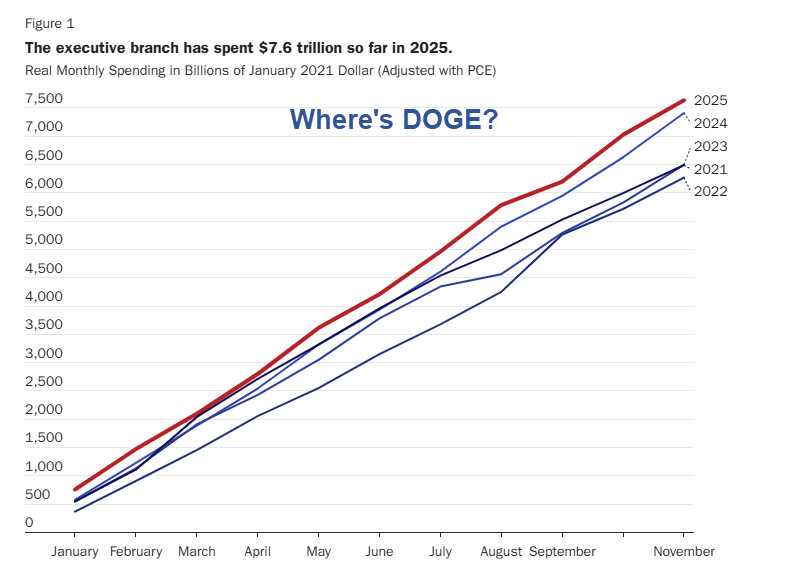
Source: Cato Institute analysis by Alex Nowrasteh and Krit Chanwong, using Monthly Treasury Statement outlays adjusted for inflation (PCE).
- Government outlays rose from $7.135 trillion to $7.558 trillion—a nearly 6% increase
- Interest payments on the national debt increased by approximately $100 billion
- National debt grew over $2 trillion since Trump's inauguration
- The Cato Institute concluded: "DOGE had no noticeable effect on the trajectory of spending"
As Slow Boring noted: "DOGE failed to cut spending because most federal spending was for entitlement programs" that remained on "policy autopilot."
USAID Dismantling
DOGE's most consequential action was the gutting of the U.S. Agency for International Development (USAID). On February 3, 2025, Musk boasted that he had "spent the weekend feeding USAID into the wood chipper." Secretary of State Marco Rubio announced in March that 83% of USAID programs—some 5,200 in all—were being eliminated, calling it "overdue and historic reform." The agency officially closed on July 1, 2025, and was absorbed into the State Department.
For detailed coverage of the humanitarian impact and estimated death toll, see our article on U.S. Foreign Aid Cuts and Dismantling of USAID.
The Death Toll and Musk's Denials
By mid-2026, the humanitarian cost of the DOGE-driven USAID dismantling had become the central question in retrospective assessments of the initiative—and the subject of an increasingly bitter public fight over Musk's personal responsibility.
The Estimates Hardened:
Dr. Atul Gawande, the surgeon and writer who served as USAID's assistant administrator for global health from 2021 to 2025, told The New Yorker Radio Hour in a July 10, 2026 episode that an estimated 700,000 people had already died as a result of the cuts, which eliminated more than 80% of USAID's programs and cut basic health-care access for some 95 million people. Gawande had been tracking the toll publicly since late 2025, citing modeling by Boston University infectious-disease mathematical modeler Brooke Nichols, whose dashboard estimates deaths from halted HIV/AIDS (PEPFAR), tuberculosis, malaria, malnutrition, and maternal-child health programs. The Harvard T.H. Chan School of Public Health has likewise concluded the shutdown "has led to hundreds of thousands of deaths."
The estimates converge across independent methodologies, though all carry uncertainty because the cuts also reduced mortality data collection:
- Nichols's Boston University tracking model put the toll at more than 750,000 deaths worldwide by July 2026—up from roughly 300,000–400,000 in late-2025 estimates
- The Center for Global Development estimates 500,000–1,000,000 lives lost per year based on actual outlay cuts (670,000–1.6 million based on obligations)
- A Lancet-published study projects the cuts could cause more than 14 million deaths by 2030, including 4.5 million children under 5, if defunding persists; Kristof cites a Lancet forecast of 9.4 million deaths by 2030 at present rates
- The Bulwark reported (in an opinion essay by Lauren Dobson-Hughes, June 29, 2026) that more than 500,000 children had already died, that roughly 200,000 more children died in 2025 than in 2024, and that the cuts produced the first reversal of a 30-year decline in child mortality—a rate that had been halved between 2000 and 2023
Musk's Denial and the Khanna Fight:
Musk—who became the world's first trillionaire in 2026—has categorically denied any deaths. After Rep. Ro Khanna (D-Calif.) said on June 22, 2026 that Musk had "possibly sentenced to death" millions of children and demanded accountability, Musk threatened to sue Khanna, declaring it "time to sue this liar." He insisted on social media: "There is not even a single dead child!" and challenged critics: "They cannot cite a single name of someone who died out of the 'millions' they falsely claim have died. Not a single name!" In Musk's defense of DOGE's process, he tweeted on June 24, 2026 that "All DOGE required was contact information of the recipients to confirm funding was not fraudulent." Forbes reported on July 1, 2026 that Musk continued escalating these unproven claims in "fiery posts" even as studies linked the cuts to child deaths.
New York Times columnist Nicholas Kristof answered Musk's challenge directly. In a July 1, 2026 opinion column, after reporting trips to affected countries, he named the dead:
- Jibia, a 10-year-old Ugandan girl in the Rwamwanja refugee settlement—ranked third of 58 students in her fourth-grade class—who died of malaria in July 2025 after the local clinic ran out of $2 insecticide-treated bed nets and anti-malaria medicines (verified against medical records)
- Yamah Freeman, a pregnant Liberian woman who hemorrhaged and bled to death while villagers carried her toward town on their shoulders, because the U.S.-provided ambulances had no fuel after the cuts
- Achol Deng, an 8-year-old South Sudanese girl, HIV-positive from birth and kept alive by American-provided medicines costing 12 cents a day, who died of an opportunistic infection after losing her caseworker and medicine access
Musk responded that "Kristof is lying through his teeth." Kristof noted that pre-cut American foreign aid cost 23 cents per $100 of gross national income and "saved a life approximately once every 10 seconds," and challenged Musk to accompany him on a reporting trip to South Sudan, Somalia, or Mozambique. The Bulwark essay documented additional named victims, including Jane Naboi (starved in a Kenyan refugee camp), one of Yagana Bulama's twins in Nigeria (malnutrition), 1-year-old Mohammad Omar in Afghanistan (malnutrition and meningitis), and Nada and Omer in Sudan (starvation). Other journalists and researchers publicly countered Musk with documented casualty lists.
The Accountability Debate:
In The Argument (an opinion outlet), Jerusalem Demsas argued on June 26, 2026 that Musk bears direct responsibility for the deaths, reconstructing the timeline: the January 20, 2025 funding freeze; Rubio's January 28 waiver for "life-saving assistance" that in practice failed to restore most programs; Musk's February 3 "wood chipper" boast; and Rubio's March 10 cancellation of 5,200 programs. The piece noted that USAID historically supplied about 40% of global government-funded health assistance and that historical modeling credits U.S. aid with preventing 91.8 million deaths over 21 years (30.4 million of them children); Kristof and The Bulwark cite a similar figure of more than 90 million lives saved over two decades, including more than 26 million by PEPFAR alone. Demsas also documented internal warnings that went unheeded: Nicholas Enrich, USAID's acting assistant administrator for global health, was placed on leave after writing memos projecting "71,000 to 166,000 additional annual deaths from malaria and 1 million additional children facing malnutrition."
Defenders of Musk did not generally contest the mortality modeling; as Kristof characterized it, some prominent conservatives instead asked why it was America's job to save children abroad and why other countries and private donors did not do more—questions Kristof called fair while noting several European countries spend up to 10 times as much on aid as a share of national income, and that PEPFAR itself was launched by evangelicals and Republicans in 2003.
Legal Challenges
DOGE faced numerous legal setbacks throughout its existence:
- A federal judge in March issued a temporary restraining order blocking DOGE employees from accessing SSA data, finding DOGE was "essentially engaged in a fishing expedition at SSA, in search of a fraud epidemic, based on little more than suspicion"
- Multiple lawsuits challenged DOGE's access to sensitive Treasury data
- Courts found tens of thousands of DOGE-initiated firings were illegal, though judges did not order workers rehired
Court Rules DOGE Used ChatGPT and "DEI" Keywords to Illegally Cancel Humanities Grants
On May 7, 2026, U.S. District Judge Colleen McMahon of the Southern District of New York issued a 143-page opinion granting summary judgment against the government over DOGE's April 2025 termination of more than 1,400 National Endowment for the Humanities (NEH) grants—more than $100 million in congressionally appropriated funds and the largest mass termination in the NEH's history since its 1965 founding. The consolidated suit was brought by the Authors Guild along with the American Council of Learned Societies, the American Historical Association, and the Modern Language Association.
McMahon ruled the terminations "unlawful, unconstitutional, ultra vires, and without legal effect," finding they violated the First Amendment, the equal protection component of the Fifth Amendment, and exceeded DOGE's statutory authority. As the Associated Press reported, she permanently barred the administration from carrying out the terminations and ordered the government to rescind the cancellation letters.
The opinion details how DOGE bypassed the agency's normal review. "There can be no serious dispute that the review process implemented by DOGE did not conform to, or even resemble, NEH's ordinary grant-review process," McMahon wrote. The court found DOGE personnel "overtook the agency's post-award administration" and "exercised decisive control over which grants would be terminated," even though the NEH's authorizing statute vests grant decisions in the agency's chairperson.
According to depositions previously reported by ABC News, two former DOGE staffers—Nate Cavanaugh and Justin Fox, neither of whom had government experience before joining DOGE—described using ChatGPT to flag grants containing terms such as "DEI, DEIA, Equity, Inclusion, BIPOC, LGBTQ" for cancellation. Asked whether he regretted people losing income, Cavanaugh said no, calling it "more important to reduce the federal deficit from $2 trillion to close to zero." Asked whether DOGE had reduced the deficit, he answered: "No, we didn't."
McMahon rejected the government's argument that any viewpoint discrimination was ChatGPT's doing rather than the government's: "ChatGPT was the Government's chosen instrument for purposes of this project, and DOGE's use of AI to identify DEI-related material neither excuses presumptively unconstitutional conduct nor gives the Government carte blanche to engage in it." She concluded that "DOGE blatantly used protected characteristics as criteria for grant termination," calling it "a textbook example of unconstitutional viewpoint discrimination."
The judge singled out the cancellation of a grant for a project on Jewish women who survived Nazi persecution. "At a time when the specter of antisemitism has reemerged from the shadows, for our Government to deem a project about Jewish women disfavored because it centered on 'Jewish cultures' and 'female' voices is deeply troubling," she wrote.
The Trump-Musk Feud
Musk's 130-day term as a special government employee ended on May 30, 2025, marked by an Oval Office ceremony where Trump praised him for leading "the most sweeping and consequential government reform program in generations" and presented him with a ceremonial "Key to the White House."
Days later, their alliance collapsed over Trump's signature legislation, the "One Big Beautiful Bill Act".
The Feud Escalated Rapidly:
- May 27: Musk criticized the bill in a CBS interview, arguing it increased the deficit and undermined DOGE's work
- June 3: Musk called the bill a "disgusting abomination" and warned supporters: "In November next year, we fire all politicians who betrayed the American people"
- June 5: The feud reached a climax when Musk claimed without evidence that Trump appeared in the Epstein files, and backed calls for Trump's impeachment
- Trump responded on Truth Social: "Elon was 'wearing thin,' I asked him to leave, I took away his EV Mandate that forced everyone to buy Electric Cars that nobody else wanted (that he knew for months I was going to do!), and he just went CRAZY!"
- Trump threatened to terminate Musk's federal contracts and subsidies
- In private calls, Trump reportedly called Musk "a big-time drug addict"
- Trump told ABC News that Musk had "lost his mind"
- In July, Trump stated at a rally: "Maybe it's time he went back to where he came from"
Financial and Political Fallout:
On June 5, Musk lost an estimated $34 billion as Tesla shares fell 15%—the company's worst day since the COVID-19 pandemic. Musk's net favorability among Republicans dropped by 20 points.
Musk briefly mused about starting a third party and unfollowed Trump allies Stephen Miller and Charlie Kirk on social media.
Reconciliation
The two men publicly reconciled at Charlie Kirk's memorial service on September 21, 2025, following Kirk's assassination on September 10. Kirk had predicted their reconciliation on his show in July, saying "it's all part of the Trump story. Sometimes things get very heated and then there's a reconciliation."
At the memorial, Musk approached Trump, and the two were seen shaking hands. Musk posted a photo with the caption "For Charlie." A lip reader reportedly captured Trump telling Musk "I've missed you."
DOGE's Quiet End
In November 2025, Office of Personnel Management Director Scott Kupor told Reuters that DOGE "doesn't exist" and was no longer a "centralized entity." Most of its functions had been absorbed by OPM and the Office of Management and Budget.
DOGE was disbanded as a centralized entity eight months before its charter's expiration date. The government-wide hiring freeze had ended, and most of the original DOGE staff had departed or taken positions in other agencies.
Formal Dissolution: DOGE "Self-Deletes" on July 4, 2026
DOGE's charter formally expired on July 4, 2026—the termination date written into Trump's original executive order. As E&E News by POLITICO reported, the entity "self-deleted" with no ceremony: its social media account had been dormant for months, the doge.gov "wall of receipts" had not been updated since January 1, 2026, and no final review or report of its work was planned. Fox Business reported that the DOGE website went dark on the deadline after claiming $215 billion in federal cuts—a figure E&E News described as "a pittance" against the roughly $7 trillion annual federal budget, and roughly a tenth of Musk's original $2 trillion promise. The most notable genuine cuts, per E&E News, were duplicative software licenses, DEI grants, and underused office leases.
The personnel arc was complete: acting administrator Amy Gleason moved to lead a health-technology office at the Centers for Medicare and Medicaid Services, and several DOGE veterans relocated to the National Design Studio. The U.S. DOGE Service technically continues to exist with a technology-modernization mission—essentially the remit of the U.S. Digital Service it replaced.
Harvard Kennedy School professor Elizabeth Linos told E&E News that DOGE "told the American people that they can't trust government" and caused "a near-immediate loss of expertise and life-saving programs" without delivering the promised efficiency gains. Rep. Mike Levin (D-Calif.) offered a blunter epitaph: "It will be remembered as a hugely destructive failure." MSNBC's Maddowblog, in commentary, called it "the White House's failed DOGE experiment" coming to "an official and overdue end."
Assessment
The New York Times concluded that DOGE's work raised "the question of whether DOGE, at its heart, was an exercise in budget cutting or in deception. It had elements of both... But among DOGE's largest claims, the bogus savings were both larger and much more common than the real ones."
Musk had promised DOGE would be "the most transparent organization in government ever" and would bring the precision of the tech world to government. Instead, the Times found, "the group became opaque, with its lack of progress obscured by errors, redactions and indecipherable accounting that few private businesses would accept." That opacity persisted to the end: the initiative expired on July 4, 2026 without any final accounting or report of what it had actually accomplished.
The Atlantic's assessment focused on the human and institutional toll:
"Grover Norquist, one of the chief ideologists of modern conservatism, used to fantasize about drowning the government in the bathtub. The Trump administration has realized that macabre dream—not merely by shrinking the state, but by poisoning its culture. It has undone the bargain that once made government careers attractive: lower pay offset by uncommon job security and a sense of professional mission."
The article documented what was lost: "The American state, a product of compromises, is tricky terrain to master... Succeeding in such an environment requires savvy veterans who have learned how to operate such an unruly machine and can model how to do so for fresh-faced co-workers. By wiping out many of the bureaucracy's most experienced practitioners, Trump has severed the chain that allowed one generation of civil servants to pass on the habits of effective government to the next."
The toll, The Atlantic noted, "will become clear only gradually. When the U.S. Fish and Wildlife Service loses the biologists who track bat populations, vulnerable species can no longer be rigorously protected. When bat populations dwindle, insects proliferate. Farmers will likely compensate by deploying insecticides, which government studies suggest can do significant prenatal harm. Government, too, is part of a delicate American ecosystem—as it erodes, crises that lay bare its indispensability will multiply."
Slow Boring's assessment captures the fiscal significance:
"Lots of rank-and-file Republican Party voters sincerely believe that it's possible to dramatically cut taxes and balance the budget without painful cuts to retirement and health care programs that they support. This isn't true, and knowledgeable people know that it isn't true... The correct update to make here is that while there are plenty of public sector practices that one can reasonably criticize, it is extremely difficult to identify true fiscal free lunches, where large sums of money can be saved without tackling some kind of politically powerful or sympathetic constituency."
The Cato Institute summarized DOGE's results: It "helped engineer the largest peacetime workforce reduction on record" while having "no noticeable effect on the trajectory of spending."
By the time the charter expired, the retrospective ledger read: a final claimed $215 billion in savings, most of it unverifiable or disputed, against rising overall spending; roughly 300,000 fewer federal workers, with the deepest losses among the most experienced; a string of court rulings finding its methods unlawful; and—per the estimates of Gawande, Boston University, and the Center for Global Development—several hundred thousand deaths abroad from the USAID dismantling that Musk continues to insist never happened.