New York Times Editorial Board Estimates Trump Has Made at Least $1.4 Billion From the Presidency
The documented scale of presidential self-enrichment is historically unprecedented—and no longer rests on outside estimates alone. Trump's own 927-page financial disclosure, filed June 30, 2026, reported at least $2.2 billion in 2025 income (versus $622 million in 2024), roughly $1.4 billion of it from crypto, including $636 million in memecoin royalties—while blockchain analysis found nearly one million retail investors lost $3.8 billion on the same $TRUMP coin.
Outside tallies range from the New York Times Editorial Board's conservative "at least $1.4 billion" to The New Yorker's $4.05 billion.
Historians call the monetization unrivaled in presidential history; even the Wall Street Journal's conservative editorial board called it "graft" that demeans the office. The absence of divestment or blind trusts, combined with direct policy benefits to industries where Trump holds financial interests, represents a fundamental departure from norms that governed every modern presidency.
Details
On January 20, 2026—the one-year anniversary of Trump's second inauguration—The New York Times Editorial Board published an analysis documenting how President Donald Trump has used the presidency to accumulate at least $1.4 billion in personal wealth. The editorial describes this figure as "an underestimate because some of his profits remain hidden from public view." Five months later, the editorial's caution proved warranted: Trump's own annual financial disclosure, filed June 30, 2026, reported at least $2.2 billion in income for 2025 alone—the first official confirmation that the true scale exceeded even the Times' estimate (see "Trump's Own Numbers" below).
A Wider Accounting: The New Yorker Puts the Total at $4.05 Billion
The Times' $1.4 billion is a floor, not a ceiling. A more expansive running tally kept by New Yorker staff writer David D. Kirkpatrick puts the Trump family's profiteering far higher. In an August 2025 investigation titled "The Number," Kirkpatrick counted only money that "in some way depended on his status as president"—excluding pre-existing hotels and golf courses, political fundraising, and "funny-money assets he couldn't readily cash out," such as his Truth Social shares—and still arrived at $3.4 billion. On January 31, 2026, he updated the tally to $4.05 billion.
The two figures differ mainly in scope: the Times restricts itself to clearly realized or near-realized income (crypto cash-outs, the Qatari jet, legal settlements, the Amazon documentary, and licensing fees), while the New Yorker also assigns dollar values to asset stakes and paper wealth the Times set aside—including Trump's roughly 42% share of Trump Media's bitcoin-and-cash holdings (about $1.15 billion) and family stakes in newer crypto ventures. Trump's officially disclosed $2.2 billion in 2025 income now sits between the two.
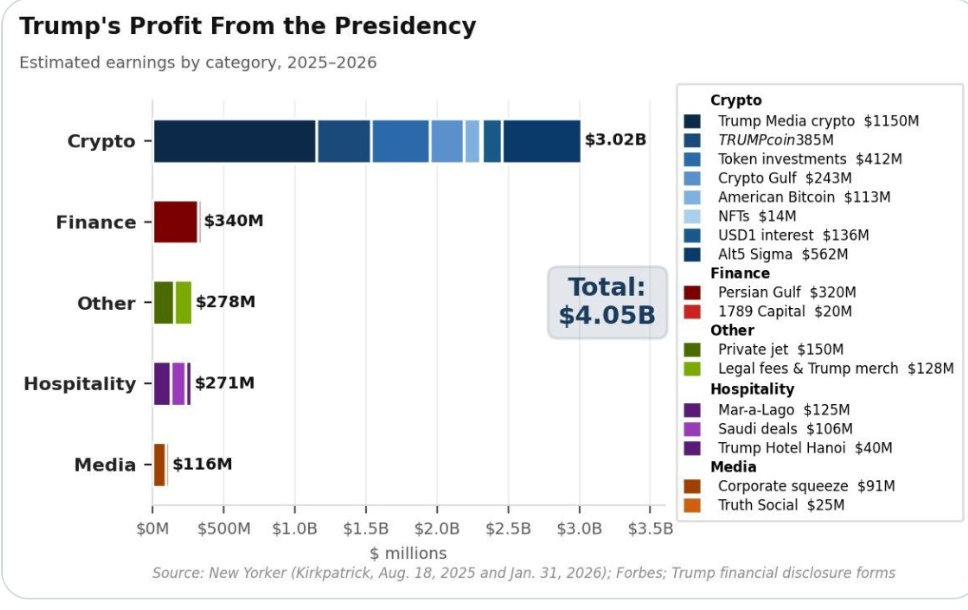
Chart by Melanie D'Arrigo visualizing The New Yorker's accounting. Source: New Yorker (Kirkpatrick, Aug. 18, 2025 and Jan. 31, 2026); Forbes; Trump financial disclosure forms. Category subtotals are approximate and overlap with the figures detailed below.
Kirkpatrick's January additions since the August tally came almost entirely from crypto: about $100 million from Donald Trump Jr.'s stake in the newly public American Bitcoin; $136 million representing the Trumps' projected ~38% cut of interest on World Liberty Financial's USD1 stablecoin, whose circulation jumped from about $2 billion to roughly $5 billion after Binance—whose founder Trump pardoned in October 2025—began paying users to hold it; and $562 million from World Liberty's sale of $750 million in governance tokens to the publicly traded shell company Alt5 Sigma (the Trump-linked entity collects 75% of token-sale proceeds). A roughly $150 million decline in the value of Trump Media's bitcoin partially offset these gains.
A separate Reuters investigation published June 9, 2026 corroborates the magnitude from a different angle, finding the family made $2.3 billion from crypto ventures alone between mid-2024 and April 2026—while the more than one million outside investors in those same projects lost a roughly equal $2.3 billion.
Breakdown of Profits
The Times' January analysis, drawing on reporting from multiple news organizations, identifies the following major income streams:
Cryptocurrency Ventures: ~$867 million
The largest source of profit. A Reuters investigation in October 2025 found that the Trump Organization earned $802 million from crypto ventures in the first half of 2025 alone—a 17-fold increase from the same period in 2024. The crypto income came primarily from two sources: $463 million from World Liberty Financial token sales and $336 million from sales of the $TRUMP meme coin. (Trump's June 2026 disclosure would ultimately show full-year 2025 crypto income of roughly $1.4 billion—see below.)
According to Reuters, analytics firm Nansen found that 36 of the 50 largest token-holding wallets, valued at $804 million, were likely connected to overseas buyers. The Financial Times reported in August 2025 that actualized profits from the meme coin alone were $385 million, with potential paper wealth in the billions.
Qatar's Boeing 747 Gift: ~$400 million
In May 2025, the Department of Defense accepted a Boeing 747-8 jet from Qatar for use as Air Force One. The plane, valued at approximately $200-400 million, will be transferred to Trump's presidential library foundation after he leaves office. Defense News reported that the Air Force expects the retrofitted plane to be ready by summer 2026.
The Air Force stated that retrofitting would cost less than $400 million, using funds repurposed from the LGM-35A Sentinel intercontinental ballistic missile program.
Legal Settlements From Tech and Media Companies: ~$90 million
Since returning to office, Trump has extracted legal settlements from multiple tech and media companies:
- YouTube/Alphabet: $24.5 million (September 2025)
- Meta: $25 million (2025)
- X (formerly Twitter): ~$10 million (February 2025)
- Paramount/CBS: $16 million (July 2025)
- Disney/ABC: $15 million + $1 million legal fees (December 2024)
Trump's June 2026 financial disclosure itemized the settlement income received in 2025 at over $86 million: Meta $24.5 million, YouTube $22 million, ABC $16 million, CBS $16 million, and X $8 million. Most funds have been directed to Trump's presidential library or toward a new White House ballroom Trump has proposed building. The Paramount settlement came three weeks before the FCC approved the company's $8 billion merger with Skydance.
Amazon's Melania Trump Documentary: $40 million
In January 2025, Amazon agreed to pay $40 million to license a documentary about First Lady Melania Trump, according to Puck News. The Wall Street Journal reported that Amazon paid far more than competing bids from Disney and Paramount—and more than the company typically pays for similar projects. The Times editorial reports Melania Trump's direct take from this deal is $28 million; the June 2026 disclosure itemized a $10.7 million licensing fee paid to the first lady for the film in 2025, plus $6 million from NFT and collectible sales and memoir proceeds.
The documentary, directed by Brett Ratner and titled "Melania," was set for theatrical release on January 30, 2026, with approximately $35 million spent on marketing.
Overseas Licensing Deals: ~$23 million (since re-election)
The Trump Organization has pursued more than 22 overseas development projects during Trump's presidency, including hotels, residential towers, and golf courses across Asia and the Middle East. Reuters reported the Trumps have made at least $23 million from licensing since the 2024 election.
Notable projects include:
- A $1.5 billion golf resort in Vietnam, which broke ground about a month before the administration agreed to lower threatened tariffs on Vietnam
- A $5.5 billion golf and real estate project in Qatar in partnership with the state-owned Qatari Diar
- A $500 million luxury resort in Oman on government-owned land
- Trump Tower projects in Saudi Arabia, Dubai, and India
Trump's Own Numbers: The June 2026 Disclosure Reports at Least $2.2 Billion in 2025 Income
On June 30, 2026, Trump filed his annual financial disclosure with the Office of Government Ethics—a 927-page document, submitted under a 45-day extension with late fees assessed. The New York Times reported that the filing shows Trump took in at least $2.2 billion in income for 2025, his first year back in office, compared with a minimum of $622 million reported for 2024. The Wall Street Journal, The Guardian, The Washington Post, and CBS News published parallel analyses of the same filing.
Crypto: roughly $1.4 billion. The disclosure shows the bulk of the haul came from cryptocurrency ventures the family launched as Trump was returning to power. The $TRUMP memecoin, launched three days before the January 2025 inauguration, generated $636 million for Trump personally—slightly more, the Times noted, than the entire amount he made from all his other business operations worldwide in 2024. World Liberty Financial, the family crypto firm Trump co-founded, has generated $799 million for the president, a significant share of it from a payment linked to the government of the United Arab Emirates: a UAE investment firm bought a 49% stake in a Trump crypto venture for $500 million in January 2025, days before the inauguration, a transaction that generated more than $200 million for Trump. CBS News's itemization breaks the crypto income into $635 million in $TRUMP memecoin royalties, more than $500 million from World Liberty Financial token sales, roughly $65 million from World Liberty equity sales, and $196 million from equity sales of Stablecoin Holdco LLC.
Real estate and hospitality. Per the CBS itemization, the Doral golf club in Florida brought in $122 million, Mar-a-Lago roughly $77 million, and the Jupiter (Florida), Bedminster (New Jersey), and Turnberry (Scotland) golf clubs more than $30 million each.
Foreign licensing. The Guardian highlighted tens of millions in fees from a flurry of new foreign deals—$10.4 million from a UAE property, $9 million from a Saudi Arabian development, $5 million from a Bucharest, Romania property, and $5 million from a Qatar property—payments flowing from countries where the administration is simultaneously making foreign-policy and arms decisions.
Merchandise, books, and settlements. Trump Watches earned $4.7 million and Trump Restaurants LLC $2.9 million, alongside sneaker, fragrance, and guitar lines; books brought in about $1.9 million from "Save America" plus smaller amounts from earlier titles and a Bible collaboration. The five media and tech settlements itemized above totaled over $86 million.
The filing was released as Trump brushed aside conflict-of-interest questions, telling reporters: "I don't get involved in my personal [finances]. We have funds that run my money"—and, in another formulation the same week, "I never speak to any of the people that run the money." The White House noted that the president is exempt from federal conflict-of-interest statutes. Unlike predecessors who divested or established blind trusts, Trump placed his assets in a revocable trust overseen by Donald Trump Jr.—and, as the Times noted, Trump remains the beneficiary of the trusts, so he still profits from the deals his sons manage.
21,000 Stock Trades—Including Purchases the Day Before the Tariff Pause
The disclosure also revealed the scale of stock trading in accounts held for the president: roughly 21,000 securities trades during his first year in office, ABC News reported. A Sludge review of the filing found that on April 8, 2025—the day before Trump announced his 90-day tariff pause, which sent the S&P 500 up nearly 10% in one of the largest single-day gains since World War II—Trump's accounts purchased 327 individual stocks worth as much as $12.8 million, including Apple, Microsoft, Nvidia, Amazon, and Alphabet at up to $250,000 each. Federal law required these trades to be disclosed in periodic transaction reports within 45 days; Trump filed no such reports for the April trades or for virtually any of his thousands of 2025 trades, which surfaced only in the annual disclosure more than a year later. The late-filing penalty is capped at $200, which he paid. NBC News confirmed the 327 previously unreported purchases. "These officials are in a unique position of having access to inside information about economic and business trends, offering a prime opportunity for insider trading," Public Citizen's Craig Holman told Sludge.
The pattern extended into 2026: a CBS News analysis of the disclosure covering January 6–March 30, 2026 counted 3,642 transactions worth between $212 million and $695 million, with timing red flags including a $500,001–$1,000,000 Nvidia purchase one week before the administration relaxed export controls on Nvidia AI chips to China. At a June 3, 2026 Senate Finance hearing, Sen. Elizabeth Warren pressed Treasury Secretary Scott Bessent on the trades, noting Trump's first-quarter trading exceeded the combined trading of all 535 members of Congress in the prior year; Bessent responded that "President Trump is not sitting in the Oval Office engaging in a high-frequency trading strategy" and declined to say whether the SEC should investigate. The Trump Organization has said that "neither President Trump, his family, nor The Trump Organization plays any role in selecting, directing, or approving specific investments."
The Other Side of the Ledger: Nearly a Million Memecoin Investors Lost $3.8 Billion
The same week Trump's disclosure revealed his $636 million memecoin payout, the crypto analytics firm Nansen calculated—in an analysis for The New York Times published July 4, 2026—that nearly one million investors lost money on the $TRUMP memecoin through the end of June 2026, with total losses of $3.81 billion. By contrast, roughly 5,000 wallets—largely insiders and sophisticated early traders—captured approximately $4 billion in gains. As the Times' Eric Lipton and David Yaffe-Bellany explained the mechanism: "Mr. Trump profited whether the price of his memecoin went up or down. He collected returns whenever anyone traded the tokens, as he repeatedly pushed his followers to do, using his Truth Social account to promote the coin."
At the time of the disclosure, the $TRUMP coin was trading around $1.67, down roughly 80% from a year earlier—meaning retail buyers absorbed the losses while Trump collected sales proceeds and trading royalties regardless of price. Gizmodo's write-up of the Nansen data put the back-of-envelope average loss at about $3,810 per buyer; TechCrunch and Fortune carried the same findings. Forbes' Dan Alexander published interviews with wiped-out investors—many of them Trump's own supporters—under the headline "'I'm Now Broke.'" California Gov. Gavin Newsom's reaction to the disclosure captured the political framing: "He got richer" while "his crypto supporters got rug-pulled."
Policy Alignment With Personal Financial Interests
The Times editorial notes that Trump has taken official actions that directly benefit industries where he holds financial interests. Critics have pointed to several areas of concern:
Cryptocurrency regulation: Shortly after taking office, the Trump administration dissolved the Justice Department's National Cryptocurrency Enforcement Team, dropped or paused SEC lawsuits against crypto firms, and removed bank warnings about crypto risks. The Times' disclosure reporting added two direct links: a February 2025 SEC statement exempting memecoins from the agency's oversight—reversing the Biden-era position—directly benefited Trump's memecoin business, and stablecoin-promotion legislation Trump signed in July 2025 came four months after his family firm introduced its own stablecoin. Trump also pardoned Binance founder Changpeng Zhao—described by the Times as "the richest man in crypto," whose company has been a critical business partner to the Trump family's own crypto venture—after Zhao served nearly four months in prison for anti-money-laundering failures.
Trade policy: The Trump Organization broke ground on a $1.5 billion Vietnamese project approximately one month before the administration agreed to lower threatened tariffs on Vietnam. Vietnamese officials reportedly fast-tracked the project, ignoring domestic laws.
"Unrivaled in Presidential History"
Accompanying its disclosure coverage, the Times published a front-page historical analysis by Eric Lipton, "Trump's Moneymaking Run: Unrivaled in Presidential History" (June 30, 2026), concluding that no president has ever monetized the office on anything approaching this scale. "It is completely unprecedented," said Megan Gorman, author of "All the Presidents' Money," a history of presidential wealth spanning 250 years; she called Trump's conduct "a betrayal of the American social contract: that those who lead the country prioritize country over self—a premise that goes back to George Washington." Historian Lindsay M. Chervinsky, executive director of the George Washington Presidential Library, noted that historically, "public office, if anything, was a source of debt, not a source of revenue."
Presidential historians told the Times they could identify no other president who entered into new business enterprises just before moving into the White House and then continued to personally profit from them in office. Past episodes were smaller, indirect, or ended under public pressure: Warren G. Harding agreed to sell his family's Ohio newspaper after questions were raised; Lady Bird Johnson transferred her broadcast stations into a trust controlled by an outside lawyer; even comparatively minor family ventures—Billy Carter's "Billy Beer," or the "Jimmy's Got It" insurance scandal that forced Franklin Roosevelt's son James out of his government post—drew intense backlash. "Presidents have worked assiduously to show they are not connected to anything that could in any way compromise their decision making," said Jeffrey A. Engel, director of the Center for Presidential History at Southern Methodist University. "The Trump White House seems to go in the opposite direction: that if we do so much of it, people will not think anything about it is weird." Presidential historian Mark K. Updegrove added: "It is the openness, the flagrant nature of what they are doing, almost with pride—cashing in on the office itself. That's what makes it dramatically different."
The Trump family has been openly unapologetic about the shift from its first-term pledge to forgo new international deals. "The first term we did everything imaginable to avoid any appearance of impropriety, and frankly, we got crushed anyway," Eric Trump said shortly before the 2024 election. "We can't just sit out in perpetuity, and I won't."
The January Times editorial made the same contrast with President Harry Truman, who "did not even own a car" when he left office in 1953 and refused jobs that would commercialize his public service, explaining: "I knew that they were not interested in hiring Harry Truman, the person, but what they wanted to hire was the former president of the United States." The editorial concludes: "A culture of corruption is pernicious because it is not just a deviation from government in the public interest; it is also the destruction of the state's democratic legitimacy."
Few Precedents Among World Leaders
A companion Times news analysis by Jason Horowitz, "Trump's Huge Windfall Has Few Known Global Precedents" (July 2, 2026; syndicated by Business Standard), widened the frame beyond American history: "No modern Western leader has ever publicly disclosed such big windfalls while in office." Silvio Berlusconi—long considered the mold for a mogul-politician accused of self-serving governance—disclosed earnings in the tens of millions of dollars while serving as Italy's prime minister; Trump's disclosed $2.2 billion breaks that mold entirely. Experts told the Times the Trump family's earnings have moved him "into an echelon of enrichment more associated with strongmen in Russia and Turkey," drawing comparisons to Vladimir Putin's alleged hidden fortune and to Asian dynasties like those of Thailand's Thaksin Shinawatra and Malaysia's Najib Razak—both of whom, unlike Trump, were criminally convicted. The article notes that Trump and his family have not been accused of violating the law, and that the president is exempt from the divestment requirements that bind other senior U.S. officials.
The analysis emphasized the damage to international anti-corruption norms. "How the U.S. behaved was quite influential in shaping international norms," said Liz David-Barrett, director of the Center for the Study of Corruption at the University of Sussex; Trump's windfall has undermined the idea "that there is a standard to which we should all be aspiring," making it easier for other leaders to ask "'why should I regulate my behavior?' when the greatest power in the world" is not regulating its president. Political scientist Fernando Jiménez Sánchez observed that since Watergate the United States had helped set the global anti-corruption standard—a standard now being demolished: "This is what is being lost." Trump himself, the piece notes, said of his deal-making in January: "I found out that nobody cared." Ynet reported that corruption experts were alarmed by the scale, and Rep. Mike Levin (D-CA) circulated the piece to Republican colleagues underscoring that a sitting president "made $2.2 billion in one year."
Even the Wall Street Journal Calls It "Graft"
Reaction to the disclosure marked a milestone in conservative opinion. On July 1, 2026, The Wall Street Journal's editorial board—Rupert Murdoch's flagship conservative page, normally friendly territory—published "The Trump Family and 'Honest Graft'", an opinion piece declaring that "the Trump clan is cashing in on the Presidency in big and sketchy ways" and that the family's dealings "demean the office." The editorial cited the disclosure's $1.4 billion from crypto, including $635 million in memecoin royalties and $593 million from World Liberty Financial token and equity sales, and emphasized what distinguishes this from past presidential-family controversies such as Hunter Biden's: how brazenly open the self-enrichment is. It highlighted that World Liberty's co-founders include the president, his sons, and Middle East special envoy Steve Witkoff—whose son Zach Witkoff is the firm's CEO—meaning the man negotiating U.S. policy in the Gulf co-founded a crypto firm receiving Gulf money, including Abu Dhabi fund MGX's roughly $2 billion investment routed through World Liberty's stablecoin to Binance. The board warned that foreign actors "are being led to believe they can buy American goodwill or favors" by cutting the Trump family in. The Hill and Raw Story covered the editorial as a notable break from the president's usual allies.
The critique has spread across the commentary spectrum. The Ringer's Derek Thompson devoted a June 19, 2026 episode of his Plain English podcast to a "corruption draft" ranking the administration's scandals, asserting: "This is the most corrupt administration in American history. That's not just my personal opinion, or the NYT's conclusion, although it is both. Several conservative commentators, including Ann Coulter, have said the same." And "Regime Change," the June 2026 book on Trump's second term by Times reporters Maggie Haberman and Jonathan Swan, devotes one of its four sections—titled "Plunder"—to the family's self-enrichment, which Rolling Stone's review characterized as corruption on an unprecedented scale.
Ethics Expert Response
Government ethics experts have characterized the situation as unprecedented. Virginia Canter, who served as senior ethics counsel for the Treasury Department under both Republican and Democratic administrations, told CBS News: "In terms of prior presidents in the modern age, they've all divested their assets, or they've rolled them over into what we call blind trusts. President Trump did not do that in his first term, and it seems as if in the second term he's doubled down."
Carter Davis, assistant professor of finance at Ohio State University, reviewed the Reuters analysis and observed: "Even if you go through and you do the most conservative estimate…it's pretty wild that you end up with such a huge fraction of the income coming from crypto."
House Judiciary Committee Ranking Member Jamie Raskin released a staff report in November 2025 stating: "Donald Trump has turned the Oval Office into the world's most corrupt crypto startup operation, minting staggering personal fortunes for him and his family in less than a year."
The June 2026 disclosure intensified these warnings. The Guardian reported "alarm bells over conflict of interest" from ethics watchdogs at the spectacle of a sitting president earning more than $2 billion from businesses regulated by his own government and from foreign-linked ventures—while remaining legally exempt from the federal conflict-of-interest statutes that apply to every other executive-branch official.
White House Response
The White House has denied any conflicts of interest. Deputy Press Secretary Anna Kelly told DL News: "President Trump's assets are in a trust managed by his children. There are no conflicts of interest." Responding to the disclosure coverage, Kelly added that Trump "proudly made the United States the crypto capital of the world" through his executive actions, and said in May: "President Trump only acts in the best interests of the American public. Which is why they overwhelmingly re-elected him to this office, despite years of lies and false accusations against him and his businesses from the fake news media."
White House Communications Director Steven Cheung told Newsweek: "Everything President Trump does is to benefit the American people. In order to serve this country, President Trump gave up a life as one of the most successful businessmen in the world and a wildly successful media mogul."
A lawyer for World Liberty Financial disputed the Reuters calculations, stating: "The Alleged Valuation and Income Analysis of WLFI Is Inaccurate and Misleading."
Methodology
The Times' January editorial relied on publicly available information and analyses from news organizations, describing its $1.4 billion figure as a minimum, not a full accounting; licensing and crypto estimates were drawn from a Reuters analysis published in October 2025 based on data from the first half of 2025, and $Melania meme coin estimates from The Financial Times. Trump's own June 30, 2026 disclosure—reporting at least $2.2 billion for calendar 2025—provided the first official accounting, and it too understates the total: disclosure forms report many income items only in broad ranges, exclude ventures held by Trump's sons rather than the president directly (such as recent investments in military contractors, prediction-market companies, and critical-minerals mining firms seeking federal assistance), and leave unclear how much of some revenue went to the Trumps versus their business partners.