POLITICO Analysis Finds Sharp Partisan Disparity in Trump's Approval of Federal Disaster Aid
A POLITICO investigation found that Trump approved just 23% of disaster aid requests from Democratic-trifecta states, compared to 89% for Republican-trifecta states—a disparity without precedent since FEMA's creation in 1979. An independent analysis of FEMA's own Disaster Declarations Summaries dataset (conducted by Claude Opus 4.6) confirms the core pattern: Democratic-trifecta states received just 7% of approved major disaster declarations (3 of 41) under Trump's second term, compared to 23-31% in every comparable prior 14-month window under both parties.
The pattern continued into July 2026, when Trump denied a $227 million blizzard-aid request from New York, New Jersey, Massachusetts, and Rhode Island—all of which exceeded FEMA damage thresholds—two days after approving declarations for six Republican-led states. A July 2026 House Democratic report separately found DHS diverted FEMA staff to immigration enforcement while the agency lost roughly 30% of its workforce, further degrading disaster response.
Critics note the small sample of trifecta-state requests and that Trump also denied some red states—but the historical comparison, Trump's social media posts tying aid to his election wins, and the Arkansas reversal after a phone call with his former press secretary all point to deliberate partisan considerations in what has historically been a nonpartisan process.
Details
On March 23, 2026, POLITICO's E&E News published an investigation reporting that President Trump has approved federal disaster aid requests from Democratic-led states at the lowest rate in FEMA's 47-year history—23%, compared to 89% for Republican-led states. The analysis, based on a review of approximately 2,500 natural disaster declarations dating to 1981, found that the partisan gap in approval rates is unprecedented. The denials blocked an estimated $250 million in disaster aid that would have been approved by every previous president, including Trump in his first term.
Key Findings
According to the E&E News analysis, which classified states by whether the governor and both senators belong to the same party ("trifecta" states):
Trump's 23% approval rate for Democratic-trifecta states is the lowest for any president since FEMA's creation in 1979. Every previous president since Reagan approved at least 67% of such requests. During Trump's first term, he approved 93% of Democratic-state requests, compared to 89% for Republican states.
Trump took an average of 80 days to act on requests from Democratic-led states, compared to 39 days for Republican-led states. This disparity is also unprecedented across the review period.
Eight out of ten denials for Democratic-trifecta states came despite FEMA documenting damage exceeding the agency's own financial thresholds—a standard that previous presidents from George W. Bush through Biden uniformly followed when approving Public Assistance requests.
Independent Data Analysis
Charts shown below replicate the E&E News/POLITICO methodology using OpenFEMA data (trifecta state classification).
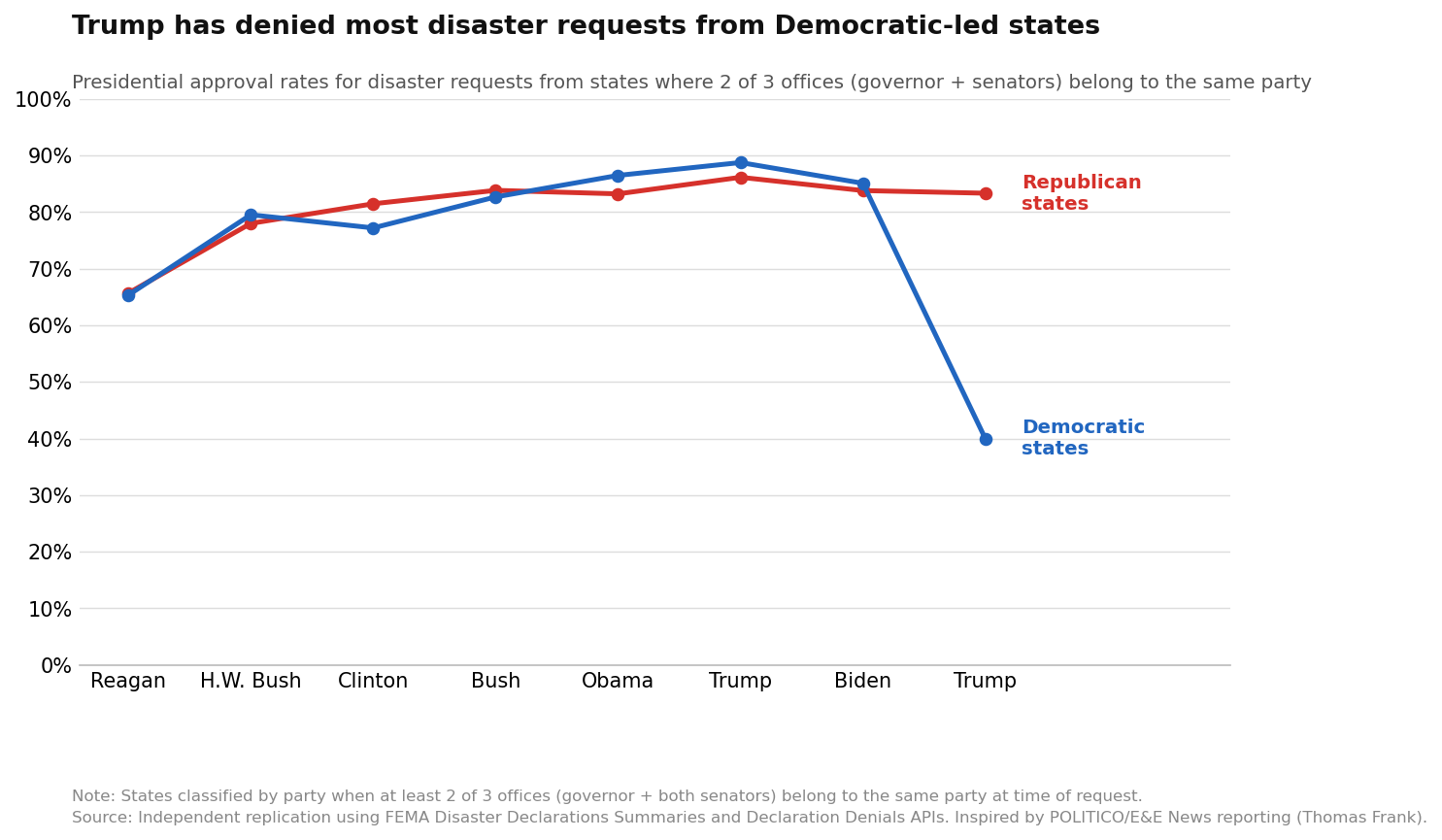
The following original analysis was conducted by Claude Opus 4.6 (Anthropic) using FEMA's publicly available Disaster Declarations Summaries dataset (v2), which records all approved federal disaster declarations dating to 1953. This dataset does not contain denials—only approvals—but the pattern of what was approved, and what was not, is itself telling.
Under Trump's second term (January 20, 2025 through March 29, 2026), FEMA approved 41 major disaster declarations. Of these, only 3 went to Democratic-trifecta states (Oregon, New Mexico, and Minnesota). The remaining 34 went to Republican-trifecta states and 4 to mixed states. Democratic-trifecta states received just 7% of all approved major disaster declarations—compared to 23-31% in every prior comparable 14-month window going back to 2017.
| Period | Dem Trifecta | Rep Trifecta | Other | Total | Dem Share |
|---|---|---|---|---|---|
| Trump 1st term, first 14 months | 15 | 36 | 13 | 64 | 23% |
| Trump 1st term, last 14 months | 13 | 35 | 7 | 55 | 24% |
| Biden, first 14 months | 18 | 35 | 11 | 64 | 28% |
| Biden, last 14 months | 34 | 60 | 17 | 111 | 31% |
| Trump 2nd term, 14 months | 3 | 34 | 4 | 41 | 7% |
Source: Independent analysis by Claude Opus 4.6 using OpenFEMA Disaster Declarations Summaries v2 (69,769 records; last refreshed March 24, 2026). "Trifecta" = governor + both senators of the same party (using current 2025-26 officeholders for all periods, which is a simplification; POLITICO classified states by officeholders at the time of each request). Excludes COVID declarations. Major disaster declarations (type "DR") only.
The data also confirms that 13 of the 16 Democratic-trifecta states—including California, New York, Washington, Illinois, Vermont, Colorado, and Maryland—received zero major disaster declarations in 14 months. All of these states received regular declarations under both Trump's first term and Biden. Washington, for example, received 4 declarations under Trump 1 and 10 under Biden. Vermont received 5 under Trump 1 and 9 under Biden. California received 16 under each.
The overall rate of declarations also dropped sharply: 2.9 major disaster declarations per month under Trump 2, compared to 4.8 per month under Trump 1 and 5.8 per month under Biden. This supports the administration's stated position that it has tightened standards generally. But the distribution of that tightening is not uniform—the reduction fell overwhelmingly on Democratic-trifecta states.
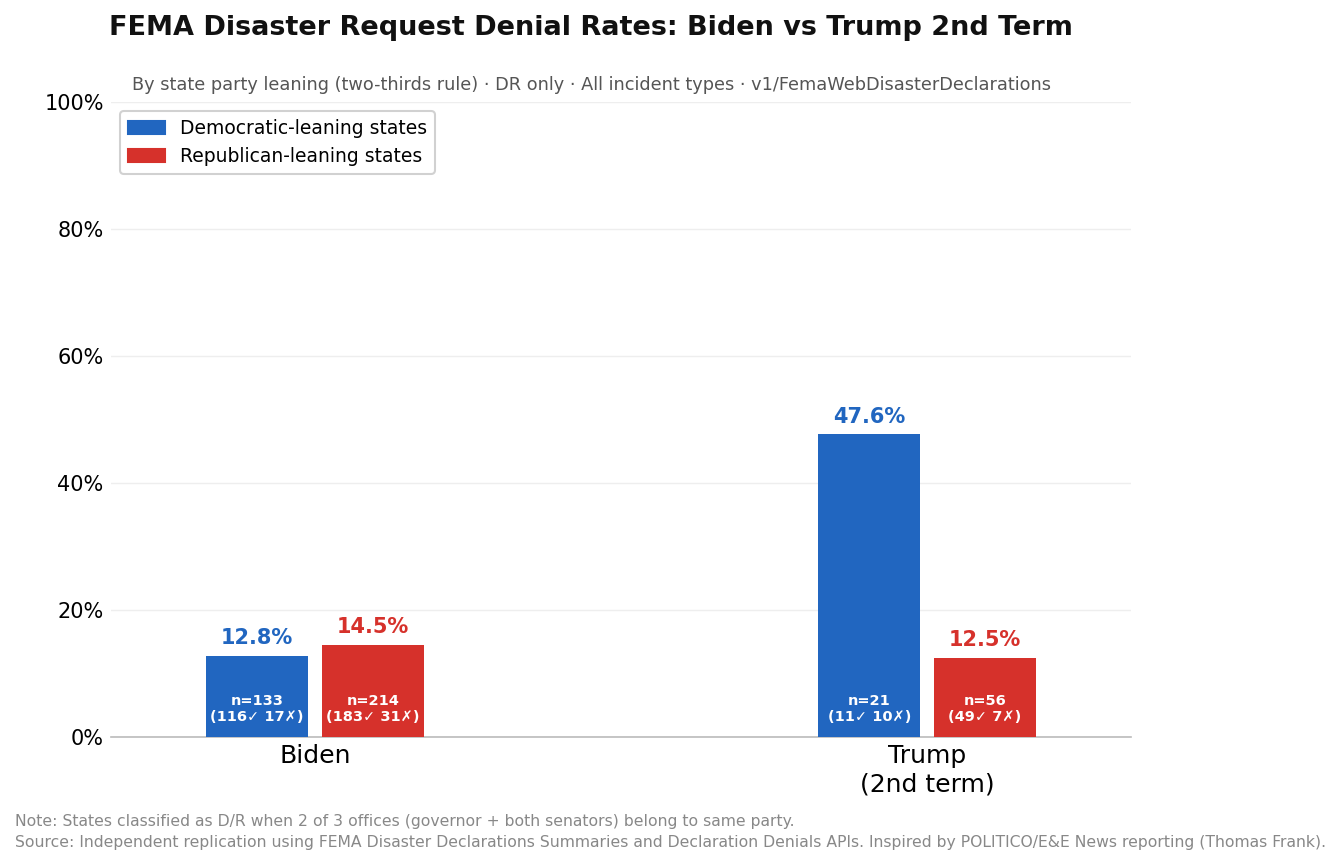
Among the 41 approved declarations, incident-to-declaration wait times averaged 94 days for Democratic-trifecta states (n=3) versus 58 days for Republican-trifecta states (n=34). While the small Democratic sample limits the statistical power of this comparison, it is directionally consistent with POLITICO's finding of 80 vs. 39 days from request to action. (Note: the FEMA dataset records incident start dates, not request dates, so these figures are not directly comparable to POLITICO's.)
Broader Context: Delays Across the Board
The POLITICO analysis builds on earlier reporting that documented a general slowdown in disaster declarations affecting states regardless of party. An Associated Press analysis published in September 2025 found that Trump's overall average wait time for disaster declarations exceeded one month—up from about two weeks under presidents in the 1990s and early 2000s. The AP noted this trend had been growing under both parties, with Biden averaging 26 days in his final year, but Trump's delays were significantly longer.
PolitiFact rated as "Mostly True" a claim by Rep. Jared Moskowitz (D-FL) that FEMA's backlog of pending disaster applications was the largest in its history, noting that as of January 2026, 18 applications awaited Trump's approval, eleven of them over a month old. The New York Times reported that a directive from DHS Secretary Kristi Noem requiring personal approval of all FEMA expenditures over $100,000 created a $17 billion bottleneck in disaster aid, including funds that regional FEMA offices had already approved for debris removal and infrastructure repairs.
Evidence of Political Motivation
Several pieces of evidence suggest the disparity is not merely a byproduct of tightened standards applied equally:
Trump's Social Media Posts. Trump has repeatedly linked disaster aid approvals to his electoral performance on Truth Social. On February 6, he wrote, "I just approved $60.6 million for the Great State of Tennessee (which I won three times!)." On October 22, 2025, announcing aid for Alaska: "It is my Honor to deliver for the Great State of Alaska, which I won BIG in 2016, 2020, and 2024." On the same day he denied requests from Illinois and Maryland, both led by Democrats, he praised Republican senators and a Republican Senate candidate in a post about North Carolina aid. In another Truth Social post, Trump announced his approval of a disaster aid request for Missouri while emphasizing the number of times he had won the state's electoral votes and praising the "incredible Patriots" in the GOP stronghold—again framing federal relief as a function of his political support there.
Sarah Labowitz, a senior fellow at the Carnegie Endowment for International Peace, told POLITICO this represented a departure from any prior administration's approach to disaster aid announcements.
The Arkansas Reversal. In April 2025, Trump initially denied disaster aid to Arkansas after deadly tornadoes, using the same boilerplate language applied to Democratic-state denials. Republican Gov. Sarah Huckabee Sanders—Trump's former press secretary—appealed the denial and spoke with Trump directly by phone. Trump reversed course on May 13, granting individual assistance. No Democratic governor whose request was denied received a similar reversal. Andrew Rumbach, a senior fellow at the Urban Institute who tracks disaster declarations, noted this case as evidence that personal political relationships were influencing outcomes.
Blue States Excluded From Funding Release. In late February 2026, CNN reported that when the Trump administration released approximately $5 billion from FEMA's backlog, California, Illinois, Minnesota, and Colorado—all led by Democrats—were excluded. DHS denied politics played a role.
Threshold Disparities. On March 18, 2025, Trump approved disaster aid for Oklahoma after FEMA estimated damages of approximately $7.5 million—less than $40,000 above the agency threshold. Meanwhile, he denied Washington state's request with $34 million in verified damage—more than double the state's $14.5 million threshold. He denied Colorado's requests involving $41 million in damage. He denied Illinois's requests involving $46 million and $83 million in home damage.
July 2026: Four Blue-State Denials Follow Six Red-State Approvals
The pattern the POLITICO analysis documented continued—and became starker—in the summer of 2026. On July 2, 2026, Trump denied a combined $227 million disaster aid request from New York, New Jersey, Massachusetts, and Rhode Island for a February 2026 blizzard, even though all four Democratic-led states exceeded FEMA's damage thresholds, The New Republic reported. Just two days earlier, Trump had approved the disaster aid requests of six Republican-led states, and on the same day he denied the four blue states, he boasted on Truth Social about granting more than $846 million in disaster relief to Republican states. E&E News/POLITICO covered the denials on July 8, and MSNBC's MaddowBlog framed the juxtaposition in a pair of pieces—"Trump denies disaster aid to four blue states, after approving aid to six red states" and "Trump approves disaster declarations for red states, as blue states go without" (both opinion/analysis commentary, July 2026).
New York Gov. Kathy Hochul said in a statement: "President Trump today denied our request for a Major Disaster Declaration following the blizzard," adding that affected communities "deserve to have access to every resource available." Rhode Island's congressional delegation was blunter: "President Trump has politicized disaster assistance for states over the last year and made it exponentially harder for so-called blue states to get disaster funding." In a separate letter to the president, the delegation wrote: "On the same day you approved major disaster declarations for several Republican-led states, you chose to leave Rhode Islanders out in the cold. It is unacceptable to politicize the disaster declaration process." Sen. Andy Kim (D-NJ) said in a statement: "If there is a reason other than politics for him and his administration to withhold FEMA assistance, we need an explanation immediately." Other Democrats' reactions were harsher still, with some describing the approach as "mob boss politics".
Around the same period, Maryland Gov. Wes Moore's office formally appealed the administration's denial of a disaster declaration for May 2026 flooding in Western Maryland, which CBS Baltimore reported had devastated communities that state officials said clearly met federal criteria. The denials of Vermont, Illinois, and Maryland in 2025, and of Colorado and California in the same timeframe, were cited as the precedent for the July 2026 batch. The Revolving Door Project maintains a running tracker of the administration's disaster-aid decisions, and Engineering News-Record reported on the growing fight over the politicization of FEMA denials.
The July 2026 denials fit precisely the profile identified in the March analysis: threshold-exceeding requests from Democratic-led states denied while Republican-led states' requests were approved in close succession, accompanied by presidential social media posts celebrating the red-state aid.
FEMA Staff Diverted to Immigration Enforcement
A separate line of congressional investigation has documented how the administration weakened FEMA's disaster capacity from within. On July 10, 2026, Democrats on the House Transportation and Infrastructure Committee's economic development, public buildings and emergency management subcommittee released a 34-page investigative report, "Stretched Thin: The Erosion of FEMA's Core Mission Under DHS," led by Ranking Member Greg Stanton (D-AZ). A Washington Post report on the probe—which The Post corroborated with previously unreported Government Accountability Office documents and interviews with current and former FEMA officials—found that DHS misused FEMA resources by diverting staff to immigration enforcement for nearly a year, "distracting the agency from its statutorily required responsibilities, jeopardizing its workforce levels and expertise, and reducing its ability to respond to disasters and aid survivors," in the report's words.
Key findings from the report and The Post's review:
Since January 2025, FEMA has lost about 30 percent of its staff—roughly 5,000 people—a higher figure than previously reported, while lacking a Senate-confirmed leader for the entirety of Trump's second term. Starting in August 2025, DHS reassigned about 125 employees from FEMA's security and human resources offices to ICE; some returned in January 2026, while others remained detailed until May 2026. Some assignments lasted more than 200 days, exceeding the 120-day guideline from FEMA's own Office of Chief Counsel. Separately, 41 FEMA employees volunteered for southern border and interior enforcement missions, and as of July 9, 2026, 13 FEMA employees were still supporting the DHS volunteer force program.
FEMA human resources staffers reviewed applications and issued job offers for the surge of new immigration enforcement officers, and FEMA helped oversee Defense Department civilian volunteers whose duties, according to a GAO document, included planning support for arrests, raids, and patrols and "managing the physical flow of detained noncitizens from arrest to deportation." A former FEMA official told lawmakers: "ICE could not have done this work without FEMA... ICE is good at law enforcement, but operations, strategy and the big picture — FEMA created that structure for them." The immigration workload consumed FEMA's hiring and administrative capacity: "Basically all human resourcing actions ground to a halt," a current FEMA official said. The report also raises Anti-Deficiency Act concerns, finding that Disaster Relief Fund-funded CORE (Cadre of On-Call Response/Recovery) employees were deployed to immigration details without reimbursement agreements; some FEMA leaders raised legality concerns at the time but the staff "still were sent over," a former senior official told The Post. DHS in some cases offered to renew the expiring contracts of CORE disaster workers if they volunteered for immigration assignments.
The consequences reached disaster survivors directly. During the July 2025 Texas floods that killed at least 137 people, call-center contracts that then-DHS Secretary Kristi Noem had allowed to lapse left hundreds of disaster survivors waiting in exceptionally long call lines while FEMA processed 60,000 disaster survivor caseloads.
The administration disputed the report's characterization. DHS spokeswoman Lauren Bis said: "There are NO, and have been, NO FEMA employees coordinating or supporting massive raids, arrests, or deportations anywhere in the United States. Claims to the contrary are simply false." She said detailing FEMA personnel security and HR specialists to ICE during a major hiring surge was "both practical and beneficial," followed standard agency processes, did not disrupt critical operations, and that the administration "ensures that Disaster Relief Fund (DRF) resources are not used for border security missions and seeks reimbursement for any non-disaster-related activities." DHS also noted that previous administrations, including Biden's, deployed FEMA to the border for humanitarian missions. Former FEMA administrator Deanne Criswell acknowledged Biden-era border deployments—for which she said she "got grilled by Republican members of Congress"—but she and five other current and former officials described the current use as a stark departure: coordinating and supporting mass immigration raids, arrests, and deportations rather than humanitarian work. Two current and former FEMA officials told The Post that some findings were mischaracterized, but agreed with the report's conclusion that FEMA's primary mission "has been measurably undermined by DHS' policy goals surrounding border security." Pete Gaynor, who ran FEMA during Trump's first term, said the findings "raise serious questions that deserve honest answers." GAO's director for emergency management issues, Chris Currie, said he was not aware of any previous instance of FEMA personnel being reassigned to hire employees for other agencies.
Stanton, who launched the investigation in May 2026, demanded the immediate recall of all FEMA employees detailed to ICE or CBP: "FEMA exists for one reason: to be there for Americans on the worst day of their lives." The report recommends making FEMA an independent, Cabinet-level agency and requiring DHS to reimburse FEMA for its immigration work. House Homeland Security Committee Ranking Member Bennie Thompson issued a statement warning of "dangerous FEMA staff reassignments during peak hurricane season," and E&E News/POLITICO covered the report as evidence that the border operations weakened FEMA. Federal News Network separately reported that FEMA workers who had sounded the alarm on disaster preparedness were reinstated in May 2026 after eight months.
While the staffing diversions are analytically distinct from the partisan pattern in declaration decisions, together they describe a FEMA whose disaster mission has been degraded on two fronts: fewer requests approved—disproportionately from Democratic-led states—and a hollowed-out workforce redirected toward the administration's immigration agenda.
Criticism of the POLITICO Methodology
The POLITICO analysis drew criticism from some who questioned its statistical rigor. A thread by data analyst @politicalmath raised several methodological concerns:
Small sample size. By filtering for "trifecta" states (governor and both senators of the same party), the analysis may involve only approximately 13 data points for Democratic states. With so few observations, two different decisions could swing the approval rate by ten or more percentage points.
Geographic confound. Republican-led states disproportionately sit in tornado alley and hurricane corridors. More natural disasters means more requests, which means more approvals. This natural baseline difference is not addressed in the POLITICO analysis.
Policy shift vs. targeting. The White House stated explicitly that Trump provides "a more thorough review of disaster declaration requests than any Administration has before him—gone are the days of rubber stamping FEMA recommendations." Trump also denied disaster aid to several Republican-led states, including Arkansas, West Virginia, Kentucky, Nebraska, South Dakota, and Oklahoma. The critic argued the data better supports "Trump tightened standards for everyone" than "Trump is targeting blue states."
Comparison problem. Every prior president rubber-stamped FEMA recommendations when damage exceeded the threshold. Comparing Trump's rates to presidents operating under a fundamentally different approach—automatic approval versus active review—may overstate the partisan signal.
The critic attempted to replicate the findings using OpenFEMA's publicly available datasets (Disaster Declarations Summaries, Declaration Denials, and Web Disaster Declarations) but was unable to reproduce the reported disparity, and noted the datasets they found did not appear to match POLITICO's figures.
Assessment of the Criticism
The methodological objections have merit as statistical cautions—small samples amplify noise, and geographic confounds are real. However, the independent analysis of FEMA's own data substantially weakens several of the objections:
The "geographic confound" argument—that Republican states simply have more disasters—is addressed by the historical comparison. Democratic-trifecta states received 23-31% of approved declarations in every comparable 14-month window going back to 2017 under presidents of both parties. That share collapsed to 7% under Trump 2. The geography of Democratic states did not change between administrations.
The "tightened standards for everyone" argument is partially supported by the data: the overall declaration rate dropped ~50%. But the tightening was not evenly distributed. Republican-trifecta states maintained exactly their historical volume of declarations (34-36 per 14-month window). The entire reduction fell on Democratic-trifecta states (from 13-34 historically to 3) and "other" states (from 7-17 to 4).
The small sample concern is valid for computing precise approval rates from the trifecta filter. But the absolute numbers tell a clear story on their own: 3 approvals for Democratic states vs. 34 for Republican states, in a period where every prior administration produced ratios closer to 1:2 or 1:3.
The tightened-standards explanation is also difficult to reconcile with the threshold data: Trump approved Oklahoma barely above its threshold while rejecting states that exceeded theirs by multiples. If the standard were applied uniformly, threshold-exceeding requests should not show a partisan pattern. The July 2026 denials sharpened this problem: all four denied Northeastern states exceeded FEMA's damage thresholds, while six Republican-led states were approved within the same week.
The "policy shift for everyone" framing must account for the timing: denials of Democratic states were announced on the same days as partisan social media posts celebrating approvals for Republican states—a pattern repeated on July 2, 2026, when Trump touted $846 million in relief for Republican states on the day he denied four Democratic-led states. It must also account for the Arkansas reversal, where a political ally obtained a different outcome through personal intervention.
Former FEMA administrator Peter Gaynor, who ran the agency during Trump's first term, told POLITICO that political considerations had "zero" effect on first-term decisions. Former FEMA chief of staff Michael Coen, who served under three Democratic presidents, confirmed that FEMA recommendations were followed approximately 100% of the time when damage exceeded the threshold.
As Rumbach wrote in February 2026, before the POLITICO analysis was published: "A year into Trump's second term, we don't have enough data to know whether these patterns of disaster denials are driven by a commitment to 'downsizing' FEMA's role, partisan politics, or some mixture of those (and other) factors."
The most defensible reading of the available evidence is that both things are true: the Trump administration has adopted a stricter posture toward disaster declarations generally, and that stricter posture has been applied more aggressively to states led by the president's political opponents. The evidence accumulated since March—the threshold-exceeding July denials paired with same-week red-state approvals—has made the partisan-application half of that reading harder to dismiss.
Administration Response
White House spokesperson Abigail Jackson told POLITICO: "There is no politicization to the President's decisions on disaster aid." She said Trump provides "a more thorough review of disaster declaration requests than any Administration has before him—gone are the days of rubber stamping FEMA recommendations."
DHS stated: "Any suggestion that disaster decisions are politically motivated does not reflect how the process works or how FEMA carries out its mission."
Neither statement addressed the specific partisan disparity in approval rates or the pattern of denials for requests that exceeded FEMA's damage thresholds. Responding to the July 2026 House report on immigration diversions, DHS denied that any FEMA employees coordinated or supported raids, arrests, or deportations, and defended the staff details as routine interagency support (see above).
Legal Framework
Trump's actions are legal. Federal law gives presidents complete authority over whether and when to approve state disaster requests. Presidential decisions are considered discretionary and cannot be challenged in court under the Stafford Act, which says the government "shall not be liable for … the failure to exercise or perform a discretionary function." There is no legal requirement for the president to follow FEMA's recommendations.
The House Democrats' report raises a distinct legal question on the staffing side: whether deploying Disaster Relief Fund-funded CORE employees to immigration details without reimbursement agreements violated the Anti-Deficiency Act. DHS maintains it seeks reimbursement for non-disaster activities in accordance with federal law.
Impact
Colorado Gov. Jared Polis told POLITICO that the denied requests "send a very bad signal" and that the state's requests were solid and "traditionally have always been granted." Maryland Gov. Wes Moore said the damage from denied May flooding "clearly met disaster assistance criteria"; his office subsequently filed a formal appeal of the denial. Washington state emergency management director Robert Ezelle, asked whether politics were involved, smiled and said he could not comment. Washington Sen. Patty Murray, the top Democrat on the Appropriations Committee, responded to the FEMA data by saying: "Never in my lifetime has a president treated disaster relief as a political cudgel. What President Trump has done to politicize disaster relief and hold up support for Americans who need it — including my constituents in Washington state — is frankly unforgivable."
As of POLITICO's March 23 publication date, Trump had not acted on 15 pending disaster requests—from Democratic and Republican states as well as native tribes—dating back to November 26, 2025, and had not acted on any requests during the partial DHS government shutdown that began February 14, 2026. By late June and early July 2026, he had cleared much of that backlog in a sharply partisan fashion: six Republican-led states approved on June 30, followed by the denial of four Democratic-led Northeastern states on July 2. New York, New Jersey, Massachusetts, and Rhode Island were left without federal assistance for February 2026 blizzard damage totaling an estimated $227 million in requested aid, and Western Maryland flood victims remained without federal individual or public assistance pending the state's appeal.